John William Waterhouse, The Lady of Shalott 1888. Tate.
16 rooms in Historic and Early Modern British Art
Prosperity in Victorian Britain helps art become spectacularly popular. Dramatic images from life and literature attract blockbuster audiences
Britain’s wealth swells in the 19th century, fuelled by imperial expansion and industrial development. While most people remain poor, many have more money and leisure time. Millions enjoy art and culture, whether reading cliff-hanger novels by writers like Charles Dickens or visiting vast imperial displays like the Great Exhibition of 1851.
Thousands queue to view popular artworks on tour throughout Britain. Better printing allows more people to see or own reproductions. Some of the paintings in this room become world famous. Acts of Parliament and wealthy donors – typically industrialists – help public galleries open, with free entry, in cities such as Birmingham, Manchester, Glasgow and London. One of these, the National Gallery of British Art, funded by the sugar merchant Henry Tate, becomes known as the Tate Gallery.
To grab the attention of these crowds, artists choose literary and modern-life subjects that reflect ideas dominating their time. They often overlook, caricature or romanticise the experiences of many people. These include women, people of colour, workers or those living in poverty. However, traces of these lives can be seen in some of the paintings here.
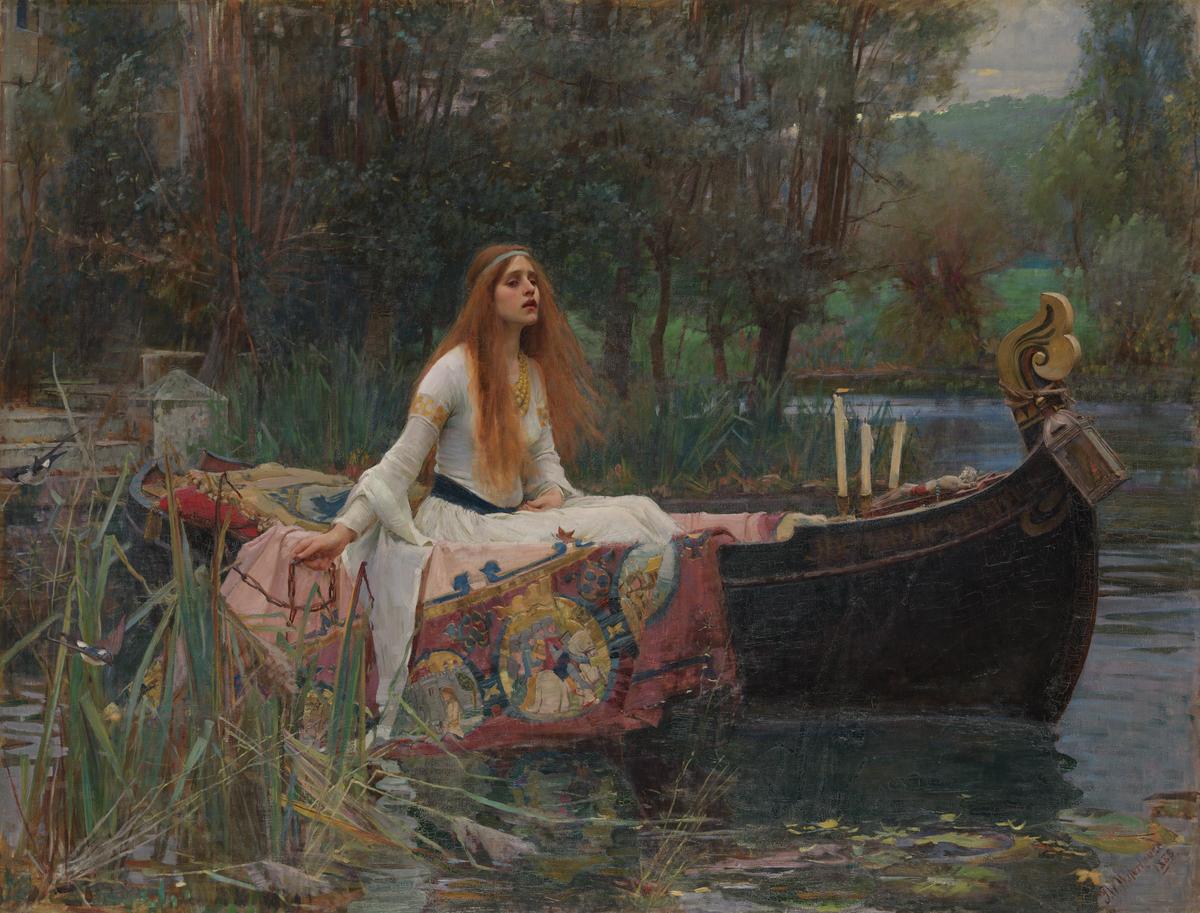
John William Waterhouse, The Lady of Shalott 1888
English poet Alfred Tennyson’s poem The Lady of Shalott (1833) describes a heroine confined to a tower and cursed to die if she looks directly upon the outside world. By using a mirror, she embroiders scenes of passers-by. When the Lady glimpses the Arthurian knight Sir Lancelot, she falls in love and defies the curse. Out in the cold world, on the point of death, she frees a boat to seek him. Lancelot is visible on her embroidery and familiar Pre-Raphaelite clues foretell her fate: house martins fly low as the wind blows her hair and extinguishes the candles.
Gallery label, September 2024
1/30
artworks in Art for the Crowd
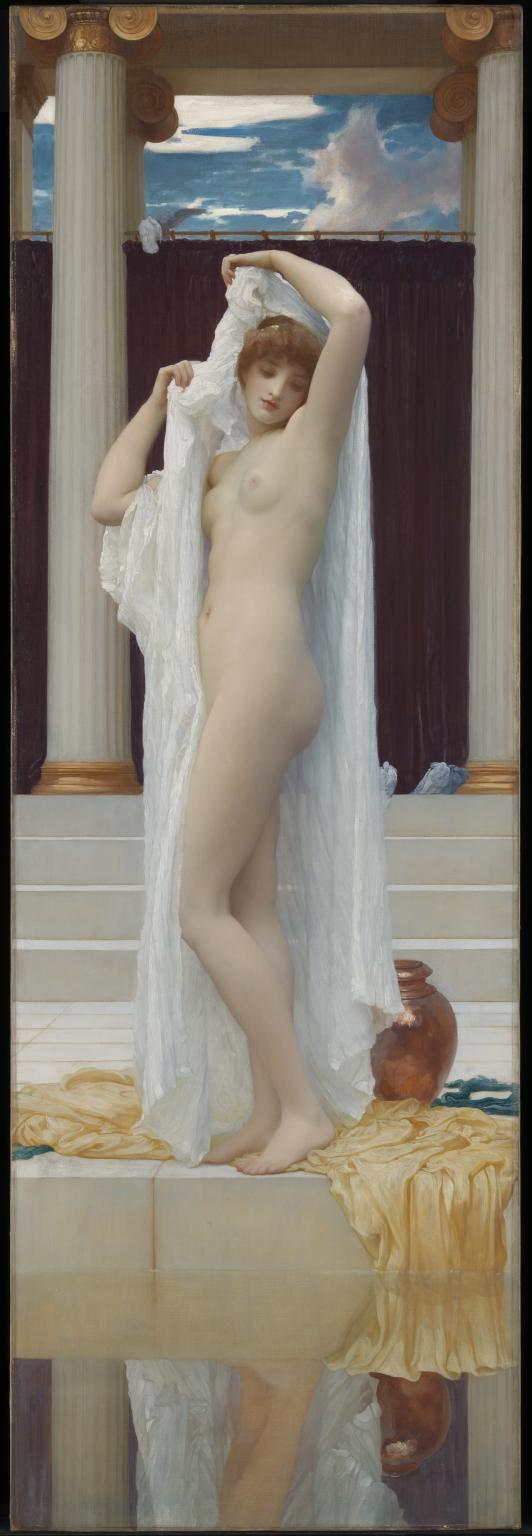
Frederic, Lord Leighton, The Bath of Psyche exhibited 1890
The story of Psyche comes from a tale by the Roman poet Lucius Apuleius. Psyche lived in the golden palace of Cupid, the god of love. Each night Cupid would visit Psyche’s bedroom to have sex with her, without revealing his identity. Here we see Psyche undressing to bathe before Cupid’s arrival, gazing at her reflection. Leighton based Psyche’s pose on an ancient statue of Venus Leaving the Bath that he’d seen in Naples in 1859. He may also have designed the frame, which echoes the architectural details in the background of the picture.
Gallery label, August 2019
2/30
artworks in Art for the Crowd
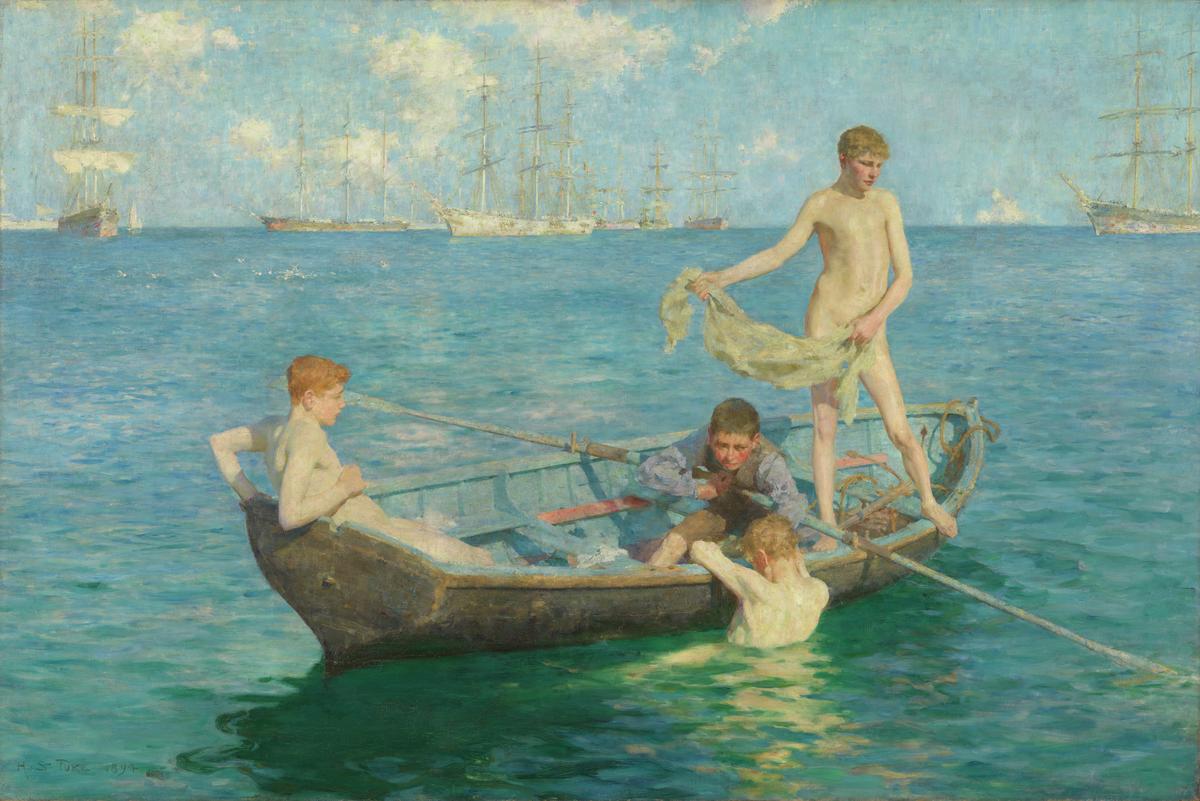
Henry Scott Tuke, August Blue 1893–4
This is one of many pictures Tuke painted of boys bathing around Falmouth Harbour, a common scene at the time. Tuke worked from life and photographs but he idealised the scene. Its poetic title (from Algernon Swinburne’s poem ‘The Sundew’ 1866) reflects the colour that suffuses the composition. Tuke grew up in Cornwall and helped found the Newlyn School, a group of artists based in Newlyn. He was well-known for his portraits of boats as well as people.
Gallery label, September 2020
3/30
artworks in Art for the Crowd
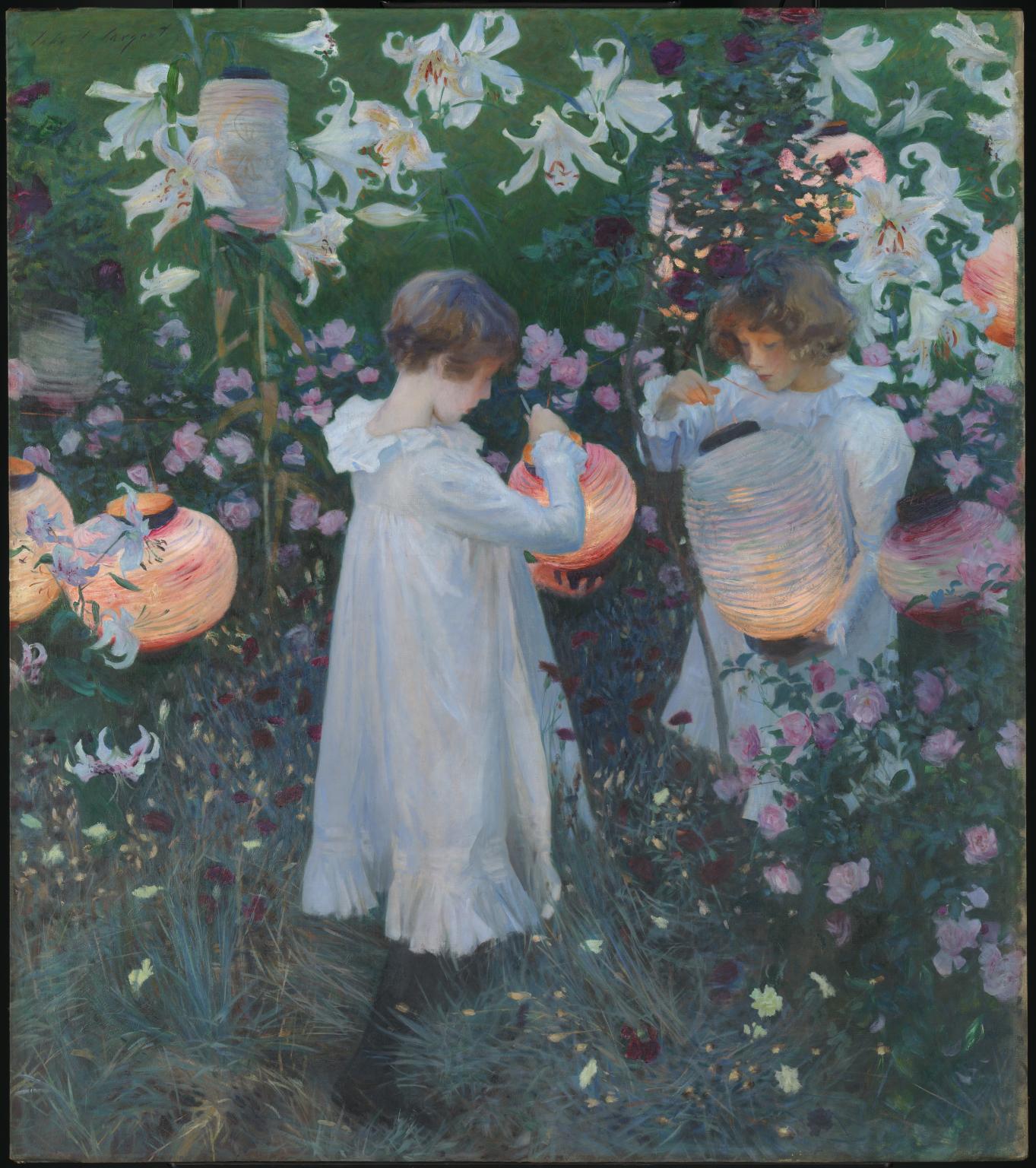
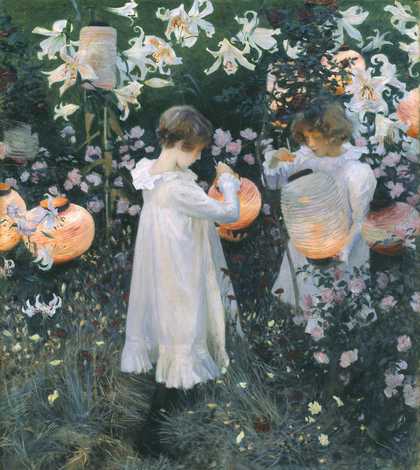
John Singer Sargent, Carnation, Lily, Lily, Rose 1885–6
John Singer Sargent painted this work from real life. He would place his easel and paints outside, pose the models, and wait for the few moments each evening when the light was just right. As summer ended and the flowers died, he replaced them with pot plants. The painting was completed over two years in Broadway, in the Cotswolds. It was one of the first paintings Sargent made after moving from Paris to London and it helped make his reputation in Britain when it was purchased for the nation through the Chantrey Bequest.
Gallery label, January 2025
4/30
artworks in Art for the Crowd
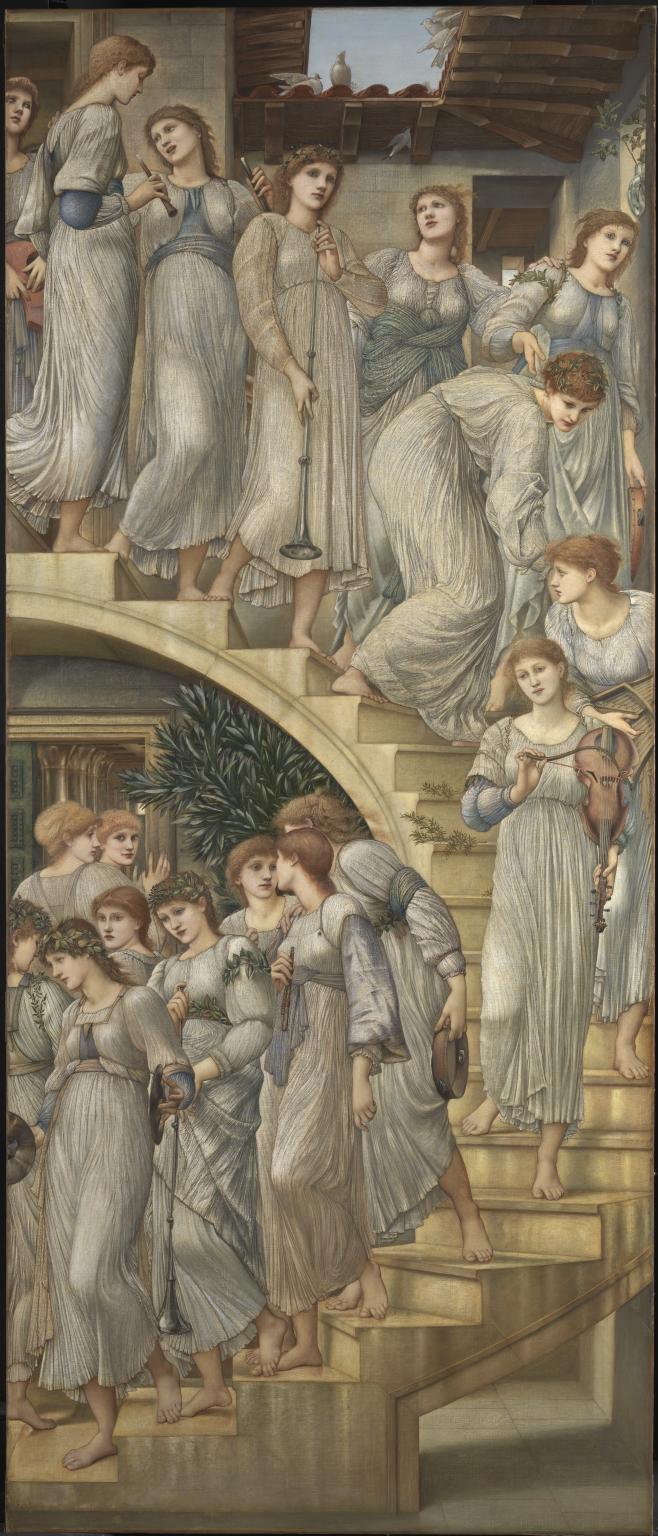
Sir Edward Coley Burne-Jones, Bt, The Golden Stairs 1880
This painting is an example of Burne-Jones’s interest in investigating a mood rather than telling a story. He deliberately made his pictures mysterious and the meaning of this work has been debated by critics. One suggestion is that the staircase, without visible beginning or end, represents continuous movement. Models for the painting include Frances Graham, daughter of Burne-Jones’s patron William Graham and Mary Gladstone, daughter of British Prime Minister WE Gladstone. Burne-Jones’s daughter, Margaret, is pictured at the top of the stairs.
Gallery label, August 2019
5/30
artworks in Art for the Crowd
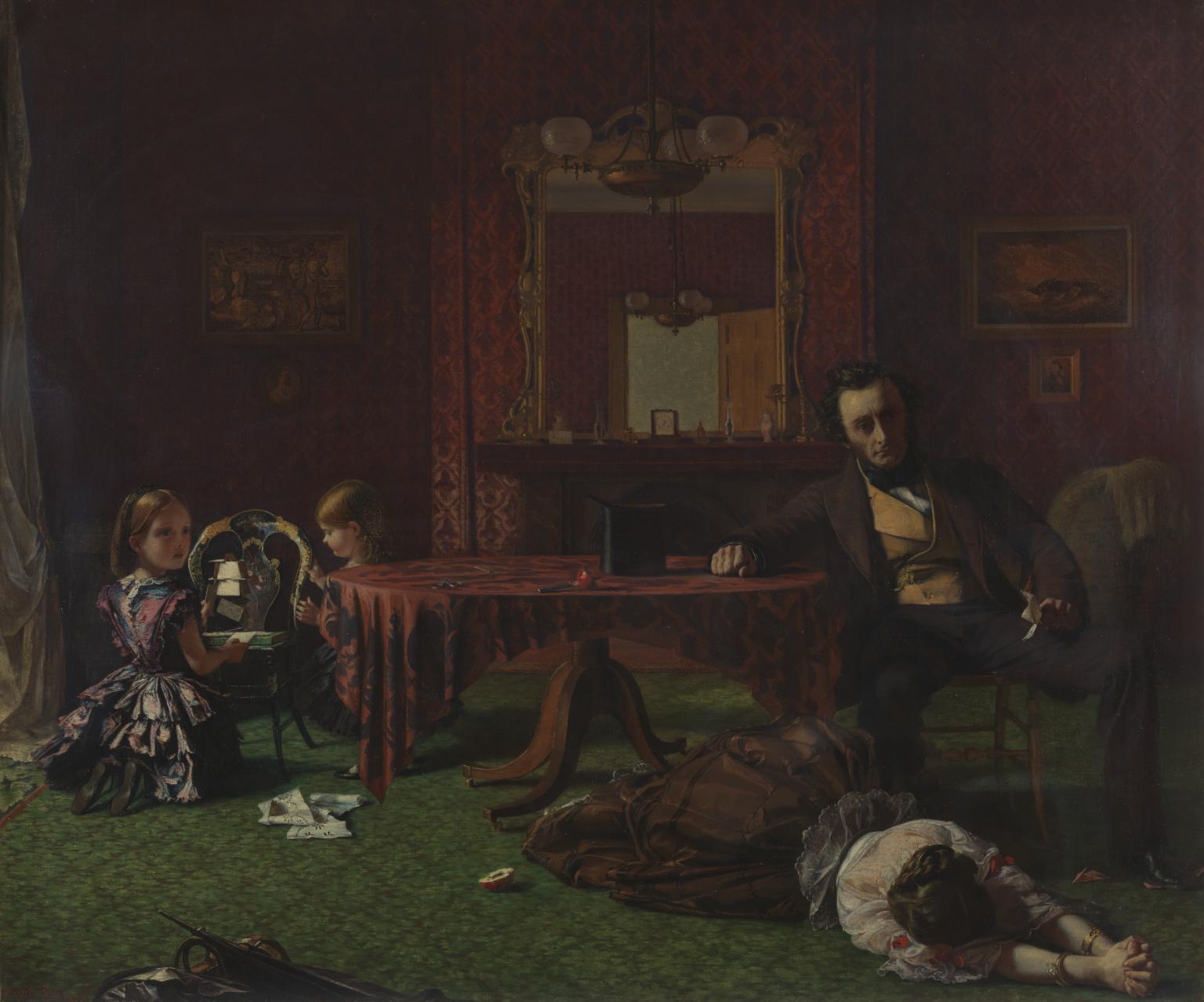
Augustus Leopold Egg, Past and Present, No. 1 1858
This painting forms part of a series of three which considers the consequences of love outside marriage In Victorian Britain. Past and Present No.1 and Past and Present No. 3 show ‘Present’ five years later, two weeks after the husband has died of despair. Identical moons indicate that they take place at the same moment. The two girls comfort each other. The homeless mother shelters under the Adelphi arches, by the River Thames in London, holding the baby that resulted from her affair. The posters for two plays, ‘Victims’ and ‘A Cure for Love’, and ‘Pleasure Excursions to Paris’, are ironic comments on her situation.
Gallery label, May 2023
6/30
artworks in Art for the Crowd
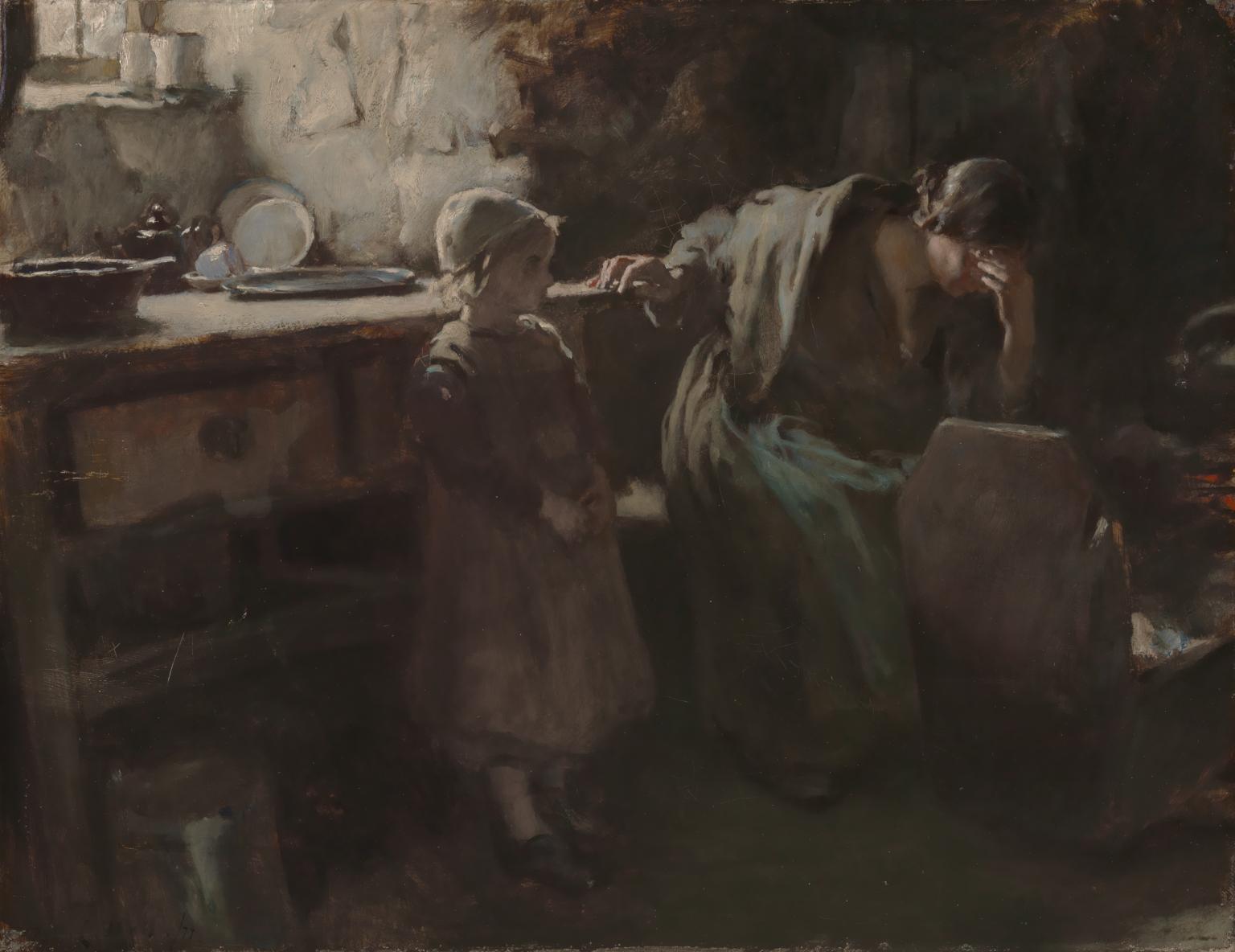
Frank Holl, Hushed 1877
Child death was a common occurrence in Victorian society. Hushed is a companion piece to Holl’s painting Hush! And shows the death of a baby. The mother covers her face with her hand in a gesture of grief, while her other child appears bewildered. Frank Holl confronts his subject directly, without sentimentality. The sombre colouring and the strong contrasts between light and shade heighten the grim mood.
Gallery label, May 2023
7/30
artworks in Art for the Crowd
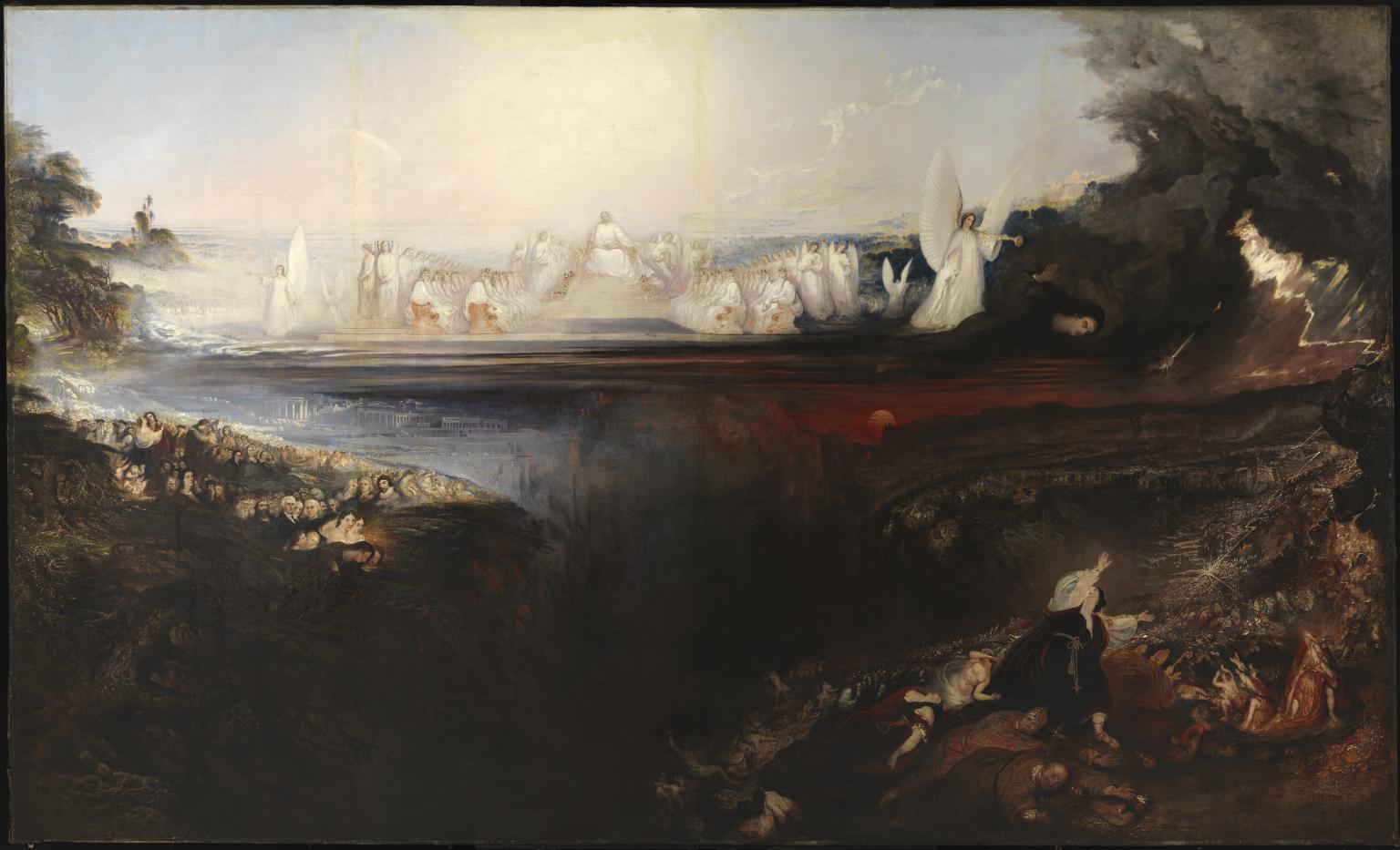
John Martin, The Last Judgement 1853
This was part of a triptych (series of three works), with The Great Day of His Wrath and The Plains of Heaven. The pictures were produced at the end of John Martin’s career, with the intention of touring them. They travelled extensively, even going on show in America and Australia. Their fame and influence helped pave the way for modern forms of popular entertainment – including blockbuster cinema.
Gallery label, August 2019
8/30
artworks in Art for the Crowd
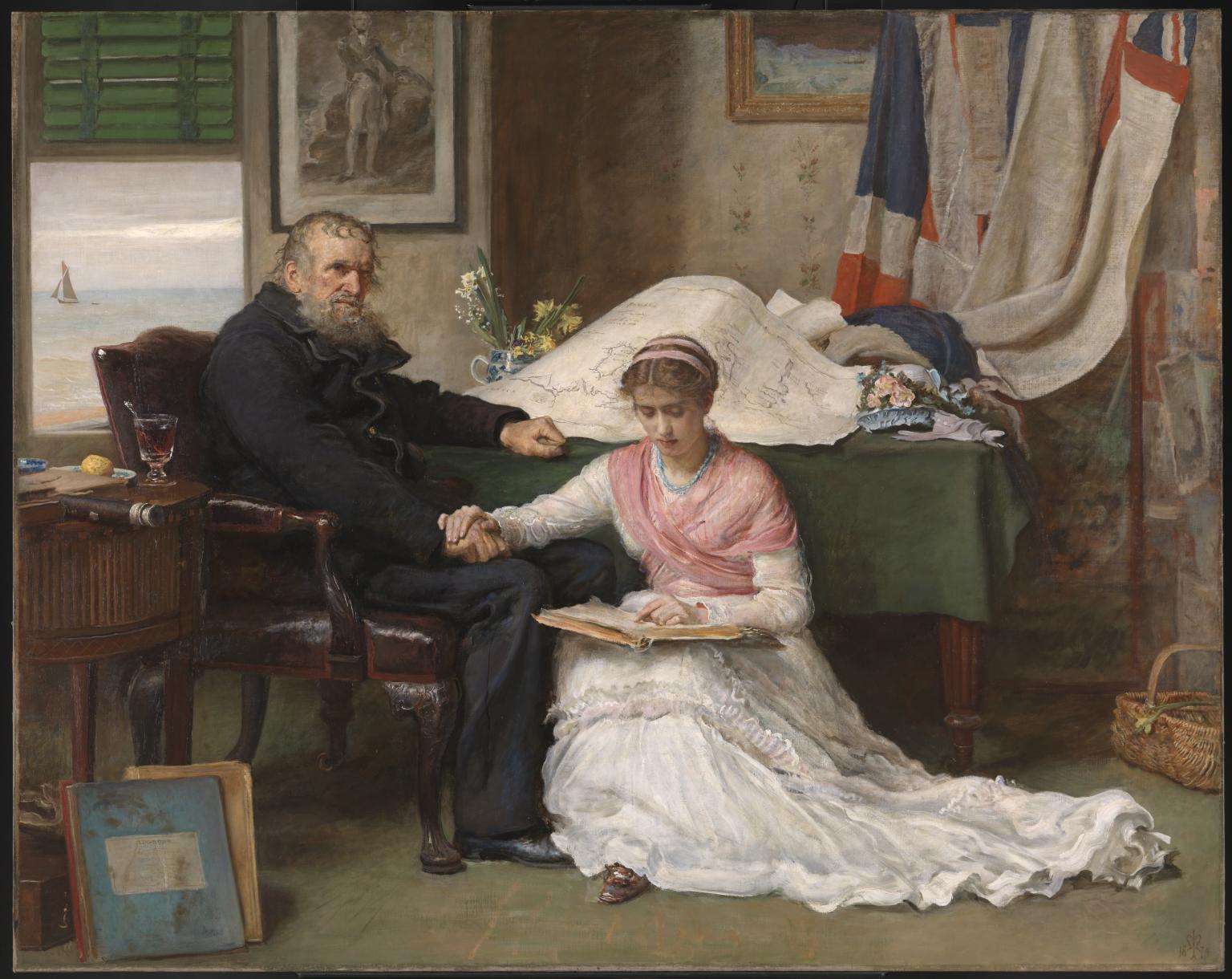
Sir John Everett Millais, Bt, The North-West Passage 1874
The north-west passage is a dangerous sea route round North America via the Canadian Arctic. For centuries, European explorers attempted to use it as a trade route to Asia. It became associated with failure, adversity and death, with ships and their crews battling against hopeless odds in a frozen wilderness. Millais painted this when an English expedition was setting off. Millais suggests the risks of the voyage through the grim expression of the old seaman. His daughter is pictured beside him, reading from a log book.
Gallery label, August 2018
9/30
artworks in Art for the Crowd
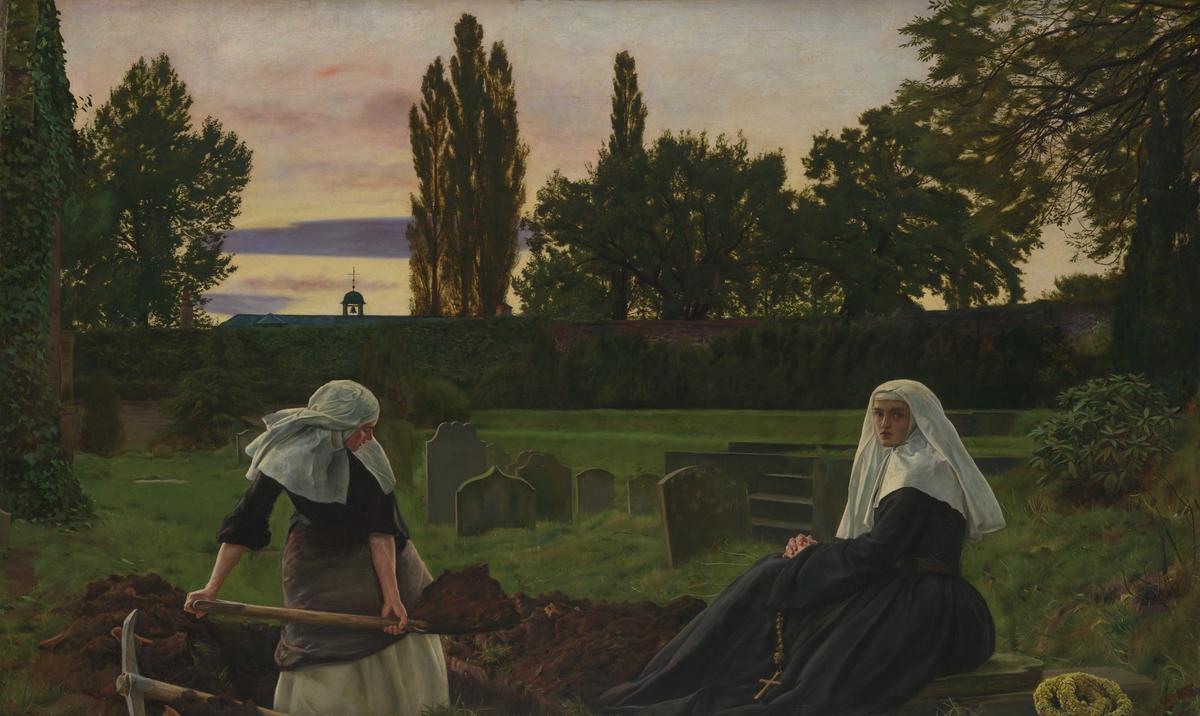
Sir John Everett Millais, Bt, The Vale of Rest 1858–9
Stirred by the spirituality and yearning in Mendelssohn’s song ‘Ruhetal’, here Millais’s theme is death, signified by the presence of the grave, skull and funerary wreaths, and in the intense and solemn colours of a graveyard touched with the last rays of a setting sun. Viewers are invited to contemplate their own mortality through the preparation of the new grave in the foreground and the nun who gazes out towards them. Despite the pain and sadness in death, the title offers hope that it will bring repose from life’s cares and an infinite contentment.
Gallery label, March 2010
10/30
artworks in Art for the Crowd
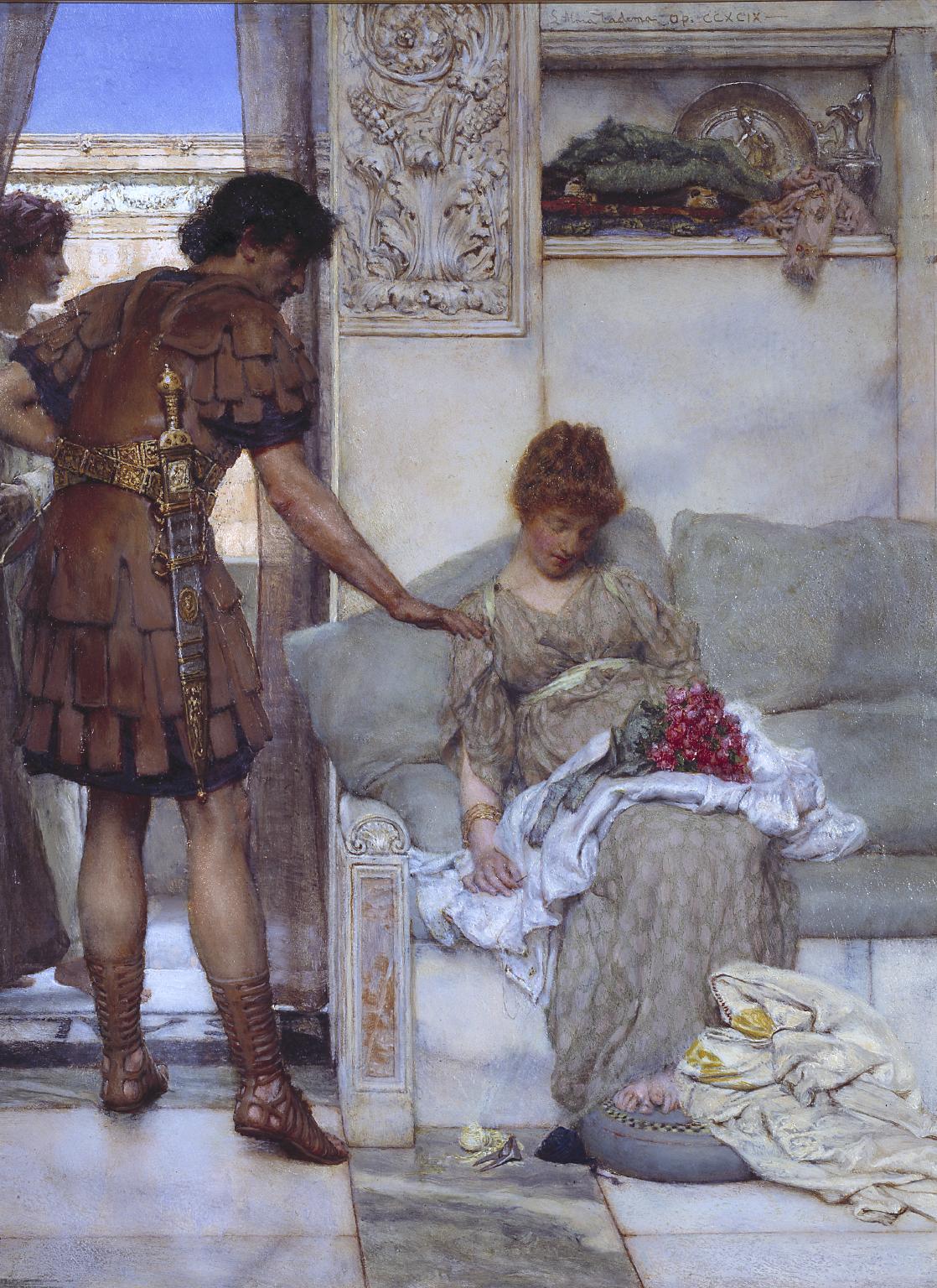
Sir Lawrence Alma-Tadema, A Silent Greeting 1889
The ‘silent greeting’ of the title is the gift of flowers that the young Roman soldier leaves for the sleeping woman. The subject was inspired by The Visit, a poem by the German poet and dramatist Johann Wolfgang von Goethe (1749–1832). Alma-Tadema took great pains over the accuracy of his depictions of the ancient world, carefully researching the architecture and interior details. However, the sentimental subject and the contemporary look of the figures – memorably described as ‘Victorians in togas’ – gives the painting the air of a modern costume drama.
Gallery label, September 2004
11/30
artworks in Art for the Crowd

Sir Thomas Brock, Sir Henry Tate exhibited 1898
This bust of Henry Tate commemorated the opening of the original Tate Gallery. Sir Henry Tate (1819-1899) had made his fortune through a new process of sugar refining and by selling sugar in neat, white cubes. In 1889 he offered to donate a collection of contemporary British art to the National Gallery. Since no suitable space could be found for these works, Tate provided the funds to build an entirely new gallery at Millbank, which opened in 1897. Brock was a successful portrait sculptor of the Victorian era, whose crowning achievement was the Queen Victoria Memorial in front of Buckingham Palace
Gallery label, February 2010
12/30
artworks in Art for the Crowd
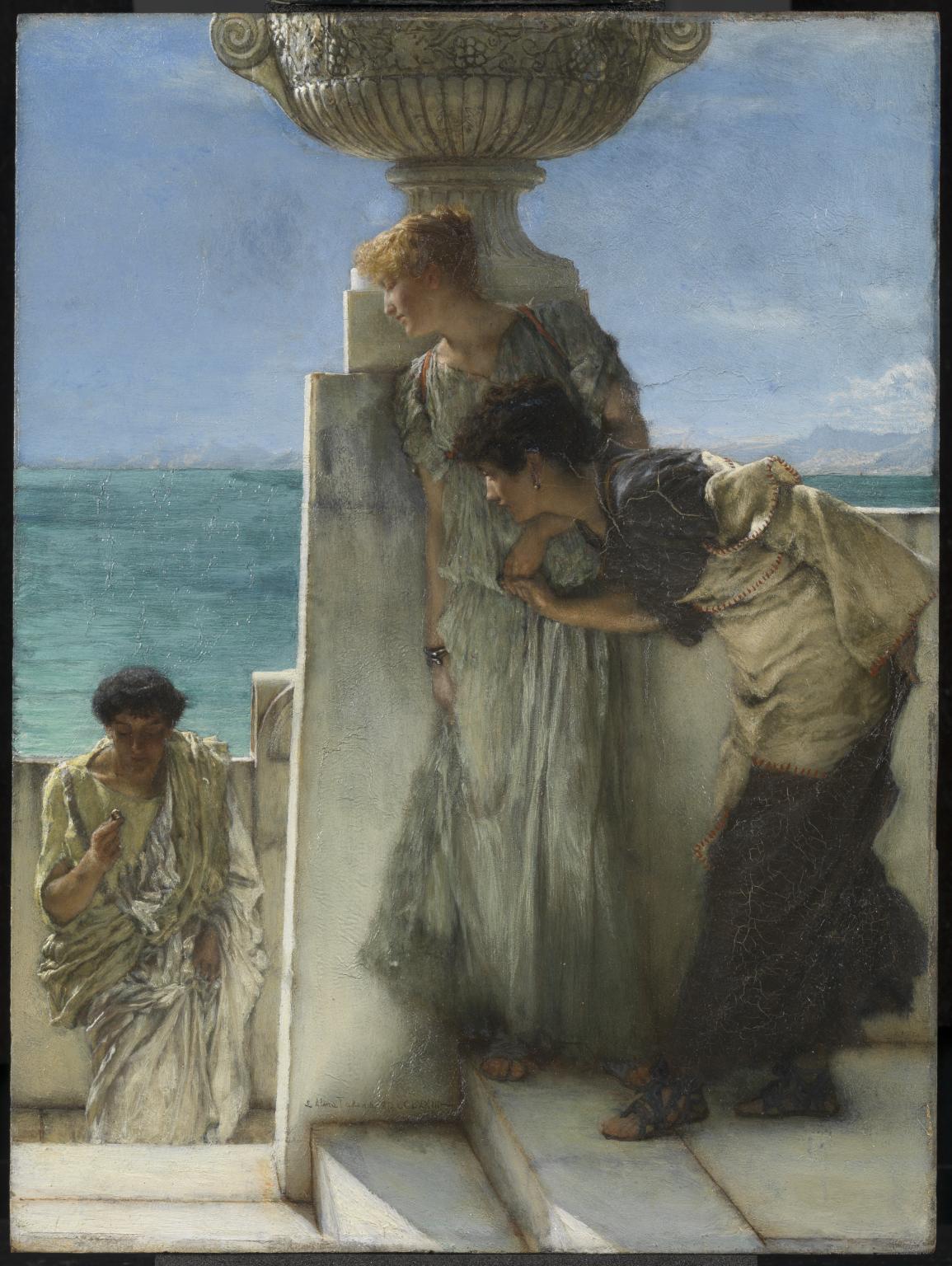
Sir Lawrence Alma-Tadema, A Foregone Conclusion 1885
A moment from contemporary Victorian life is shown here taking place in ancient Greece or Rome. A man brings an engagement ring to his girlfriend in the hope that she will become his fiancée. Her eager attitude shows that the result of his proposal is ‘a foregone conclusion’. Although Alma-Tadema took great care in the authenticity of his classical settings, the modern subject would have made the painting accessible to a nineteenth-century audience. The painting belonged to Sir Henry Tate’s second wife, Amy Hislop. They were married the year it was painted and he may have given it to her as an engagement present.
Gallery label, September 2004
13/30
artworks in Art for the Crowd
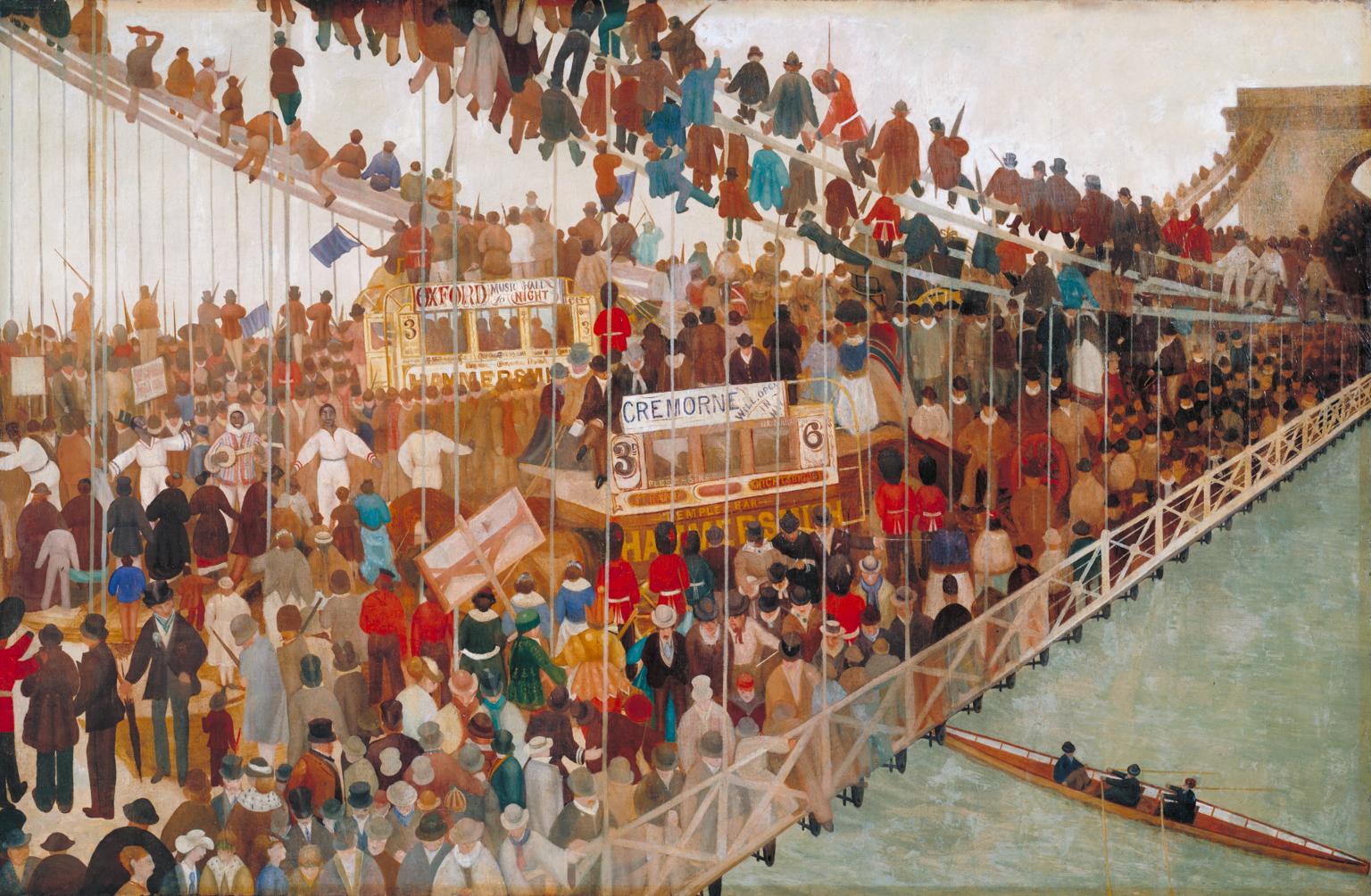
Walter Greaves, Hammersmith Bridge on Boat-race Day c.1862
Walter Greaves was the son of a Thames boatman and a self-taught painter. A dense crowd is assembled on Hammersmith suspension bridge to watch the annual university boat race. There were fears that the bridge was not strong enough to support the weight of heavy traffic when around 12,000 people gathered there for the event in 1870. Greaves captures the diversity of London at this time, although this work, painted in his early style, simplifies and caricatures the individuals in the crowd.
Gallery label, May 2023
14/30
artworks in Art for the Crowd
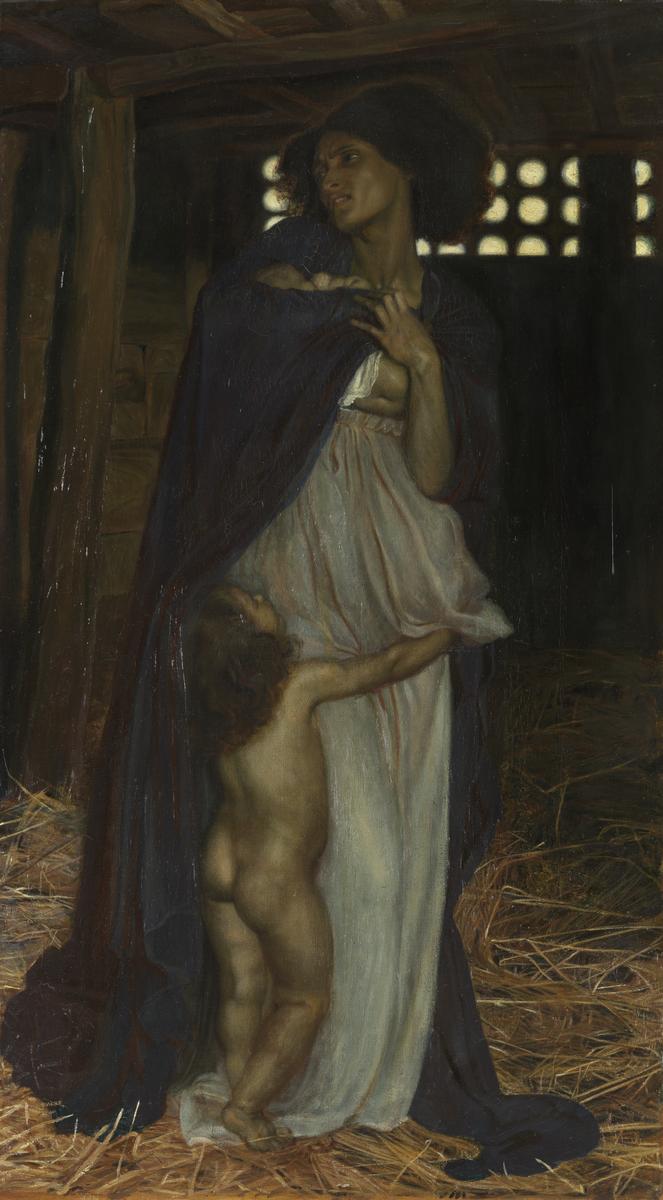
Sir William Blake Richmond, Jochebed with Moses and Miriam c.1865
This painting reflects a renewed interest in stories of slavery in Britain at the time of the Civil War between the American North and South. Many British artists were sympathetic to the cause of the North which sought to end slavery across the country. William Blake Richmond depicts the model Fanny Eaton and two of her children. Eaton was born in Jamaica, where her mother Matilda Foster, a woman of African descent, was born into slavery. Eaton moved to London with her mother when she was a child. She was a very successful model in London. She often appeared in roles which conveyed strong emotions and deep thought.
Gallery label, May 2023
15/30
artworks in Art for the Crowd
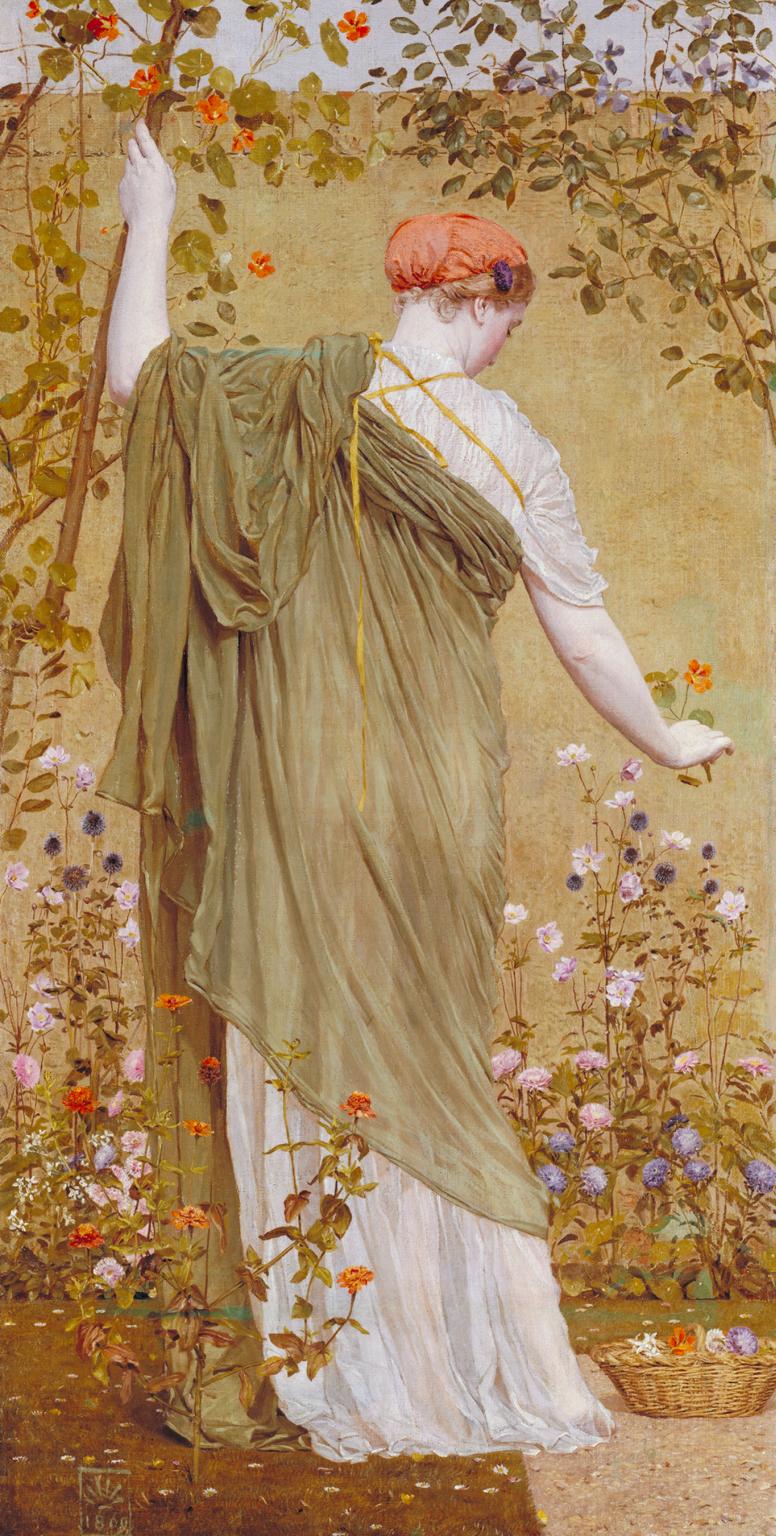
Albert Moore, A Garden 1869
Moore, like many of his contemporaries, was influenced by Japanese art. He produced decorative and subtly coloured pictures. Here, the woman’s costume allows him to concentrate on the colour, texture and movement of draped fabric. Art critic Sidney Colvin said Moore’s subjects were ‘merely a mechanism for getting beautiful people into beautiful situations’. The flower-like symbol at the bottom of the picture was used by Moore as a signature.
Gallery label, August 2018
16/30
artworks in Art for the Crowd
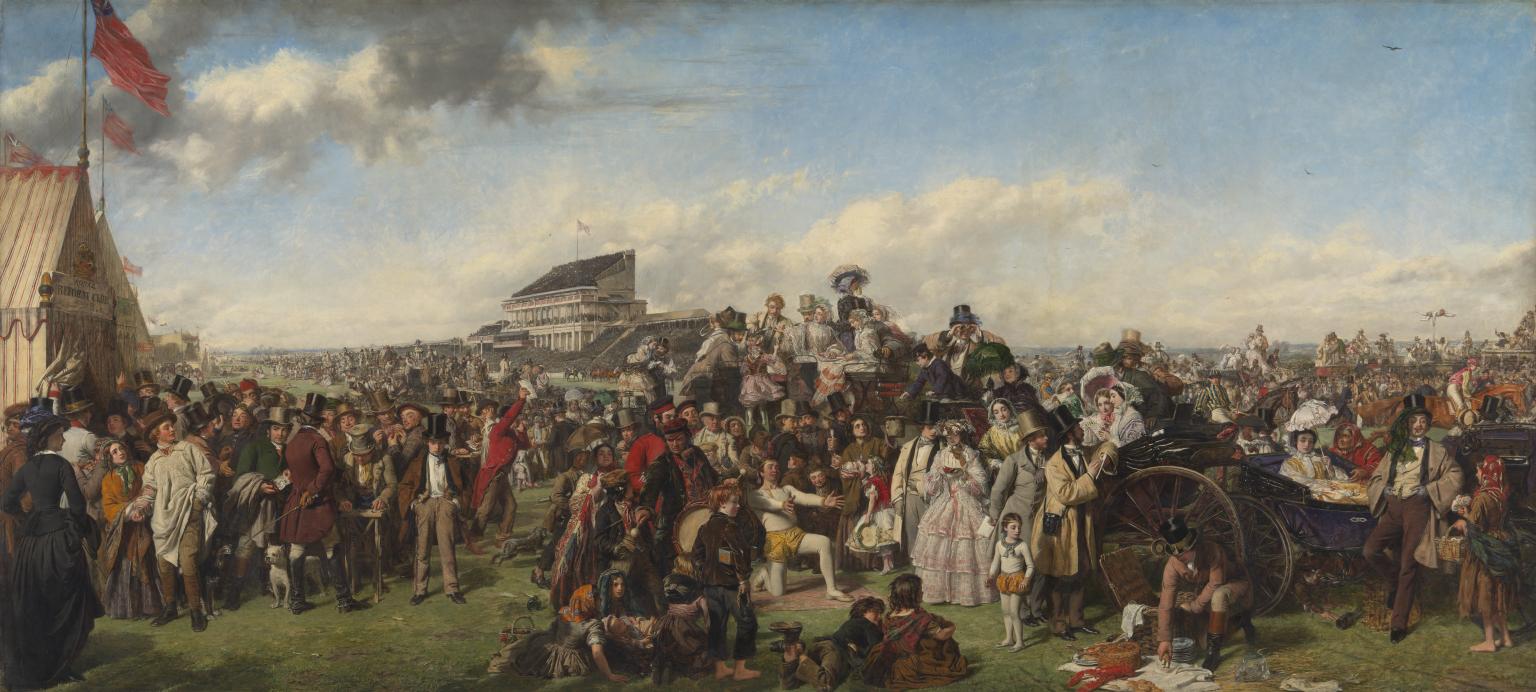
William Powell Frith, The Derby Day 1856–8
The Derby Day was first exhibited in 1858 at the Royal Academy in London. It was so popular that a barrier had to be put up to protect the work. The annual Derby at Epsom Downs racecourse in Surrey, south-east England attracted huge crowds. Frith’s detailed panorama focuses on the day’s entertainment, relegating the racing to the margins. On the left, a group of men in top hats bet on a game-playing ‘trickster’. In the centre, a crowd of bare-footed children watches an acrobat and his son. Behind them are carriages filled with racegoers enjoying Derby day.
Gallery label, November 2019
17/30
artworks in Art for the Crowd
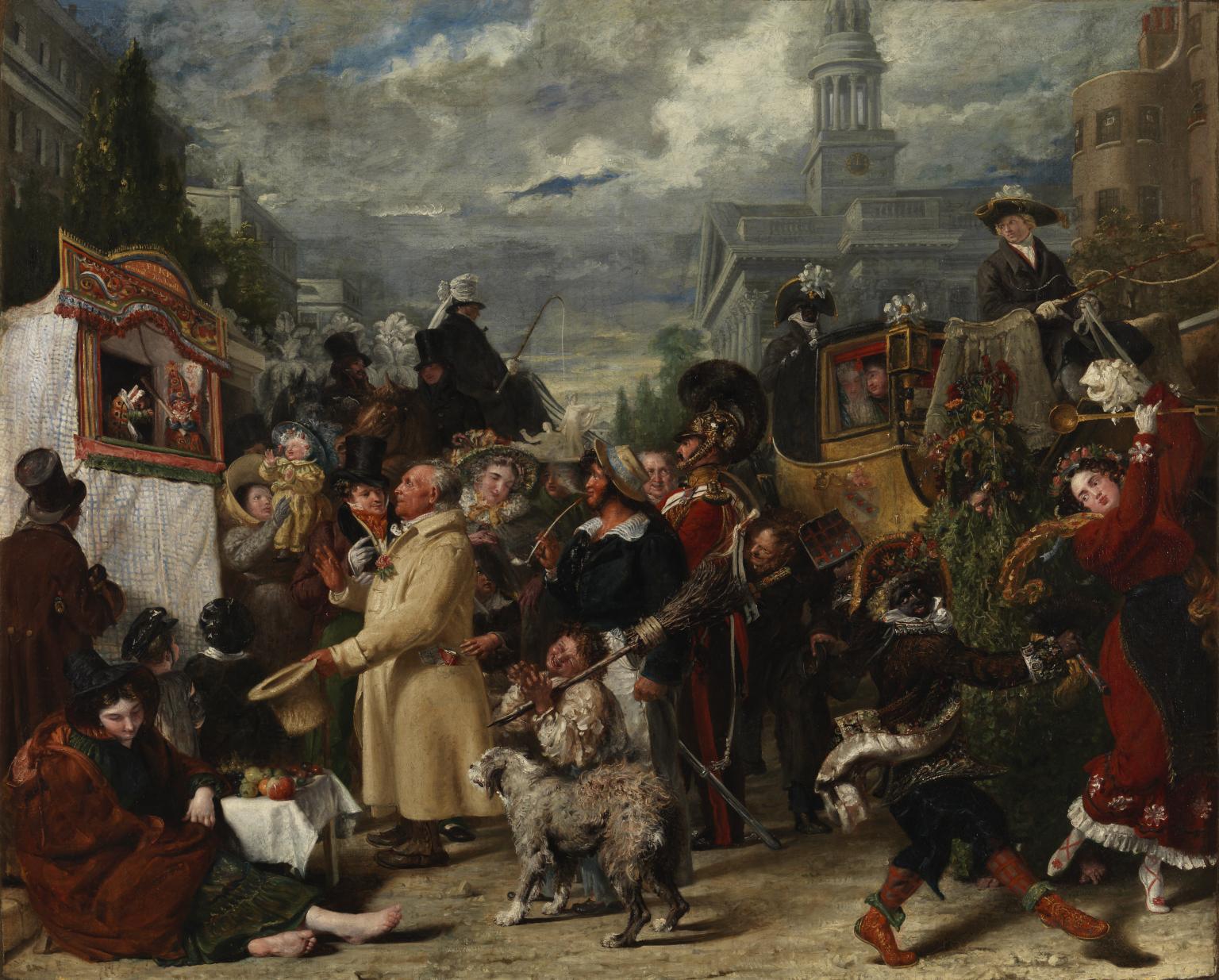
Benjamin Robert Haydon, Punch or May Day 1829
Benjamin Haydon thought of calling this painting ‘Life’, hoping to capture a cross-section of London. A hearse nearly collides with a marriage coach and the newly-weds contrast with the violent couple in the popular puppet show, Punch and Judy. Haydon made this work five years before the abolition of Slavery in the British Empire. He deliberately placed the upright Black coachman with the caricatured performance of the soot-blackened chimney sweep close together, so viewers would connect the two figures. Although he later expressed regret at his beliefs, at the time Haydon held racist ideas about racial hierarchies.
Gallery label, May 2023
18/30
artworks in Art for the Crowd
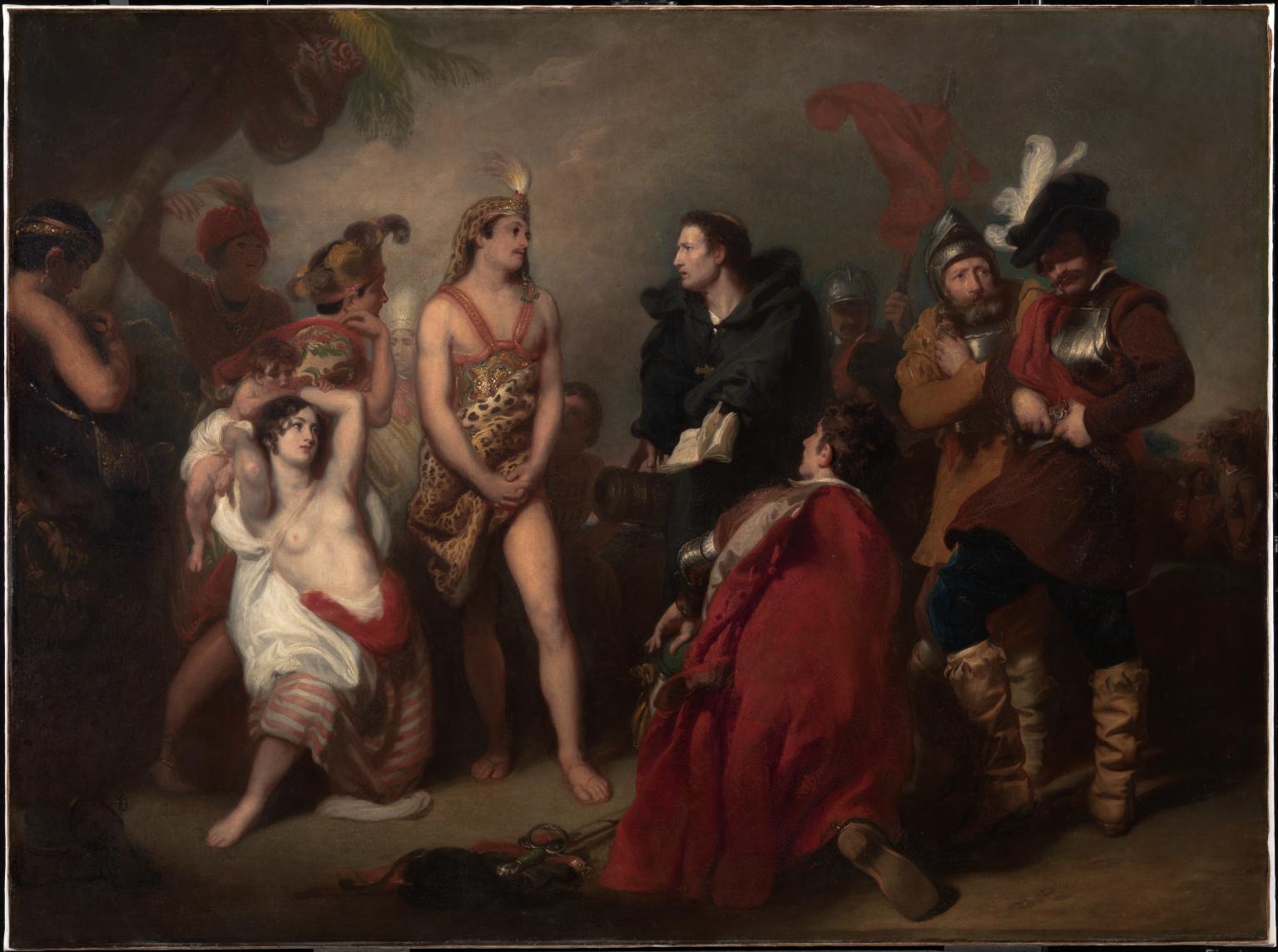
Henry Perronet Briggs, The First Interview between the Spaniards and the Peruvians exhibited 1827
Henry Briggs portrays the first encounter in 1552 between a group of Incas and Spanish conquistadors seeking to take over their land and convert them to Catholicism. While Emperor Atahualpa receives them openly, General Francisco Pizarro secretly draws a gun that will begin a massacre of seven thousand Indigenous people. When the painting was first exhibited, some viewers praised the artistic approach, rather than praising the anti-imperial theme. Briggs imagines the Incas in the tradition of classical nude paintings.
Gallery label, May 2023
20/30
artworks in Art for the Crowd
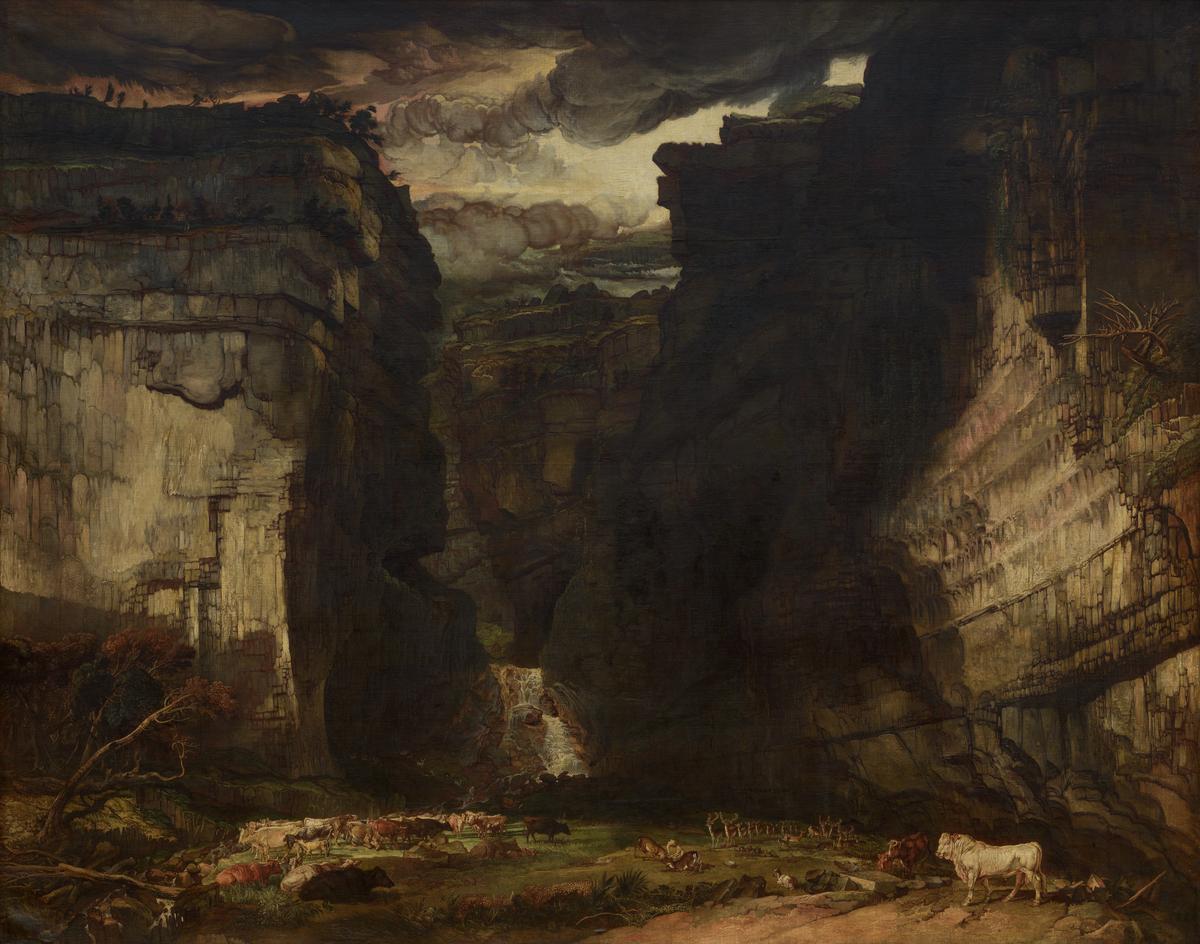
James Ward, Gordale Scar (A View of Gordale, in the Manor of East Malham in Craven, Yorkshire, the Property of Lord Ribblesdale) ?1812–4, exhibited 1815
Gordale Scar is a bank of limestone cliffs near Settle, Yorkshire. Ward painted this picture for Lord Ribblesdale, a local landowner. He emphasised the height and scale of the cliffs by subtly manipulating the perspective. In the foreground he shows deer and cattle, including a white bull from the (originally wild) Chillingham herd, who appears to guard the cleft of Gordale Beck. Working in the last years of the Napoleonic wars, Ward aimed to depict a national landscape, primordial and unchanging, defended by ‘John Bull’ in animal form. His painting also epitomised the awe-inspiring qualities of the fashionable ‘Sublime’ landscape.
Gallery label, March 2010
21/30
artworks in Art for the Crowd
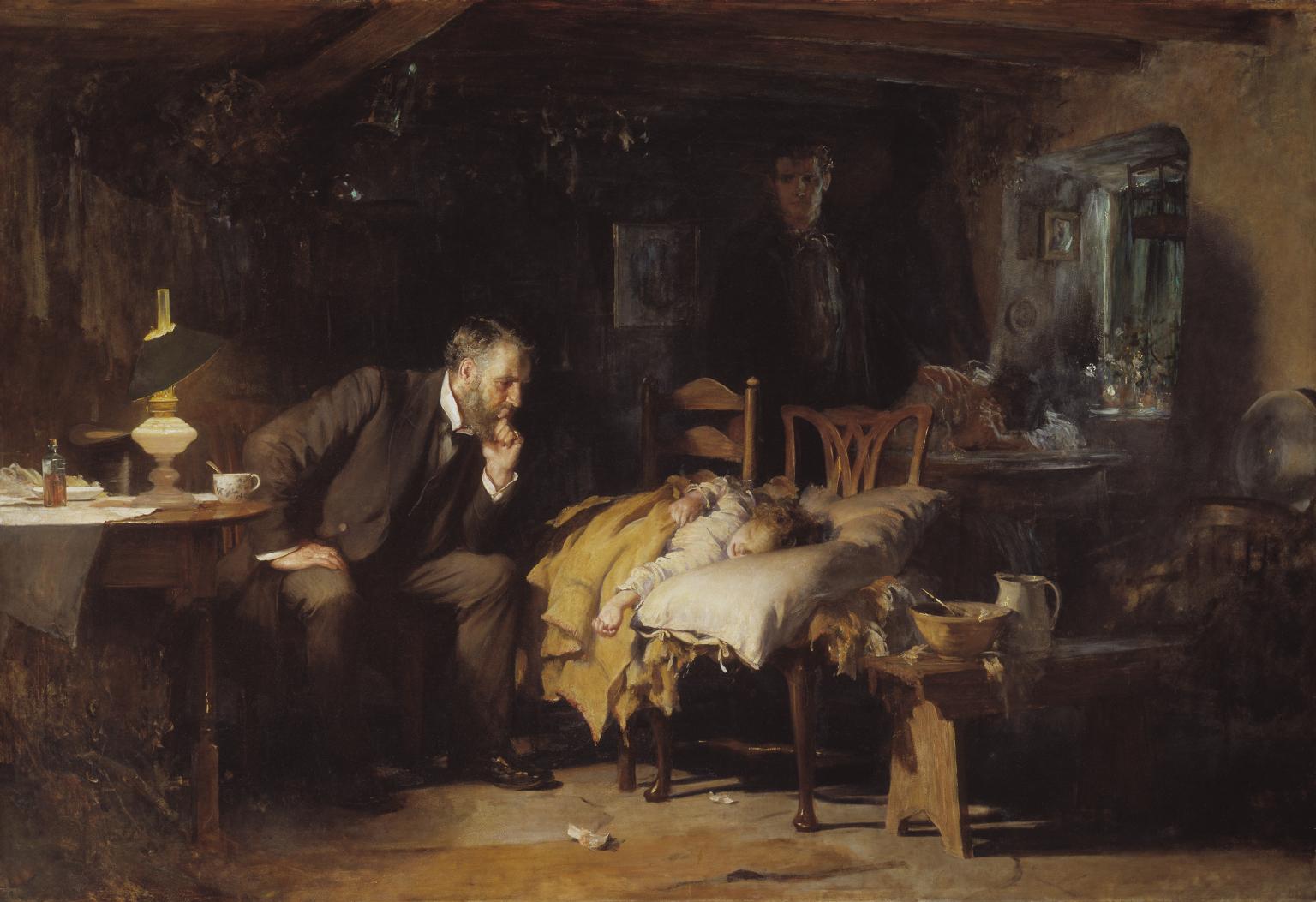
Sir Luke Fildes, The Doctor exhibited 1891
This painting depicts a child showing the first signs of recovery following a period of grave illness. The subject matter relates to a bereavement suffered by Fildes, when in 1877 his first son died at home at the age of one. Here, the figure of the doctor stands as a symbol of quiet professional devotion, capturing, as Fildes put it, ‘the status of the doctor of our time’. Behind the child, a working class father and mother anxiously await the doctor’s assessment. The sliver of dawn light at the window suggests renewed hope in the face of near-tragedy.
Gallery label, March 2022
22/30
artworks in Art for the Crowd
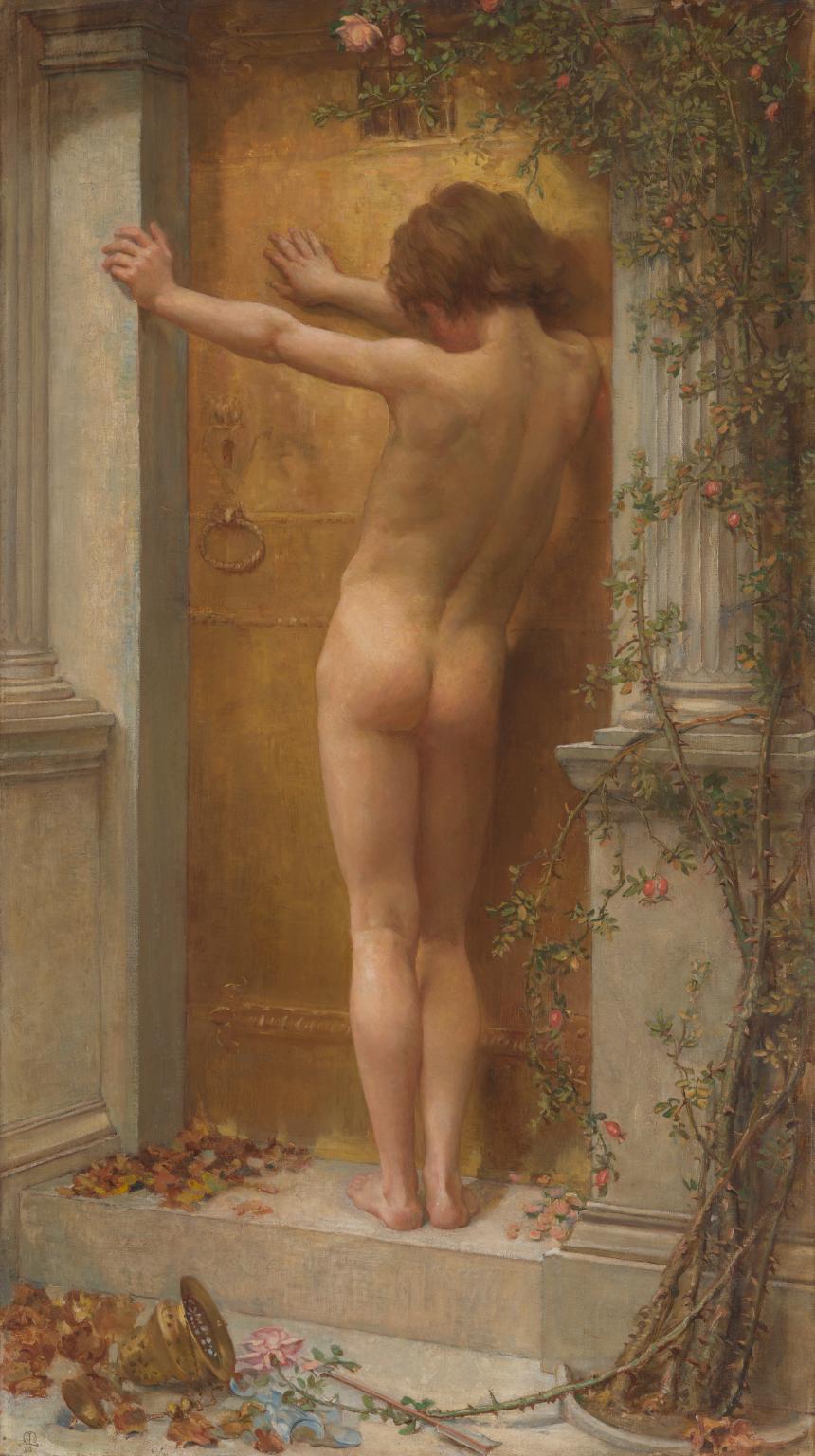
Anna Lea Merritt, Love Locked Out 1890
This picture shows young Cupid, the god of desire, pressed against the door of a tomb. It was painted as a memorial to the artist’s husband, who died just two months after they married. The thorny rose around the door frame represents the pain and persistence of love. Cupid has abandoned the world, his arrow and extinguished lamp lie on the ground with the autumn leaves. He is waiting, in the artist’s words, ‘for the door of death to open and the reunion of the lonely pair’. Merritt was a successful professional painter of a variety of subjects, including nudes. Some considered nudes unsuitable for women artists at the time. Love Locked Out proved popular when exhibited in 1890 and was bought for the nation.
Gallery label, August 2019
23/30
artworks in Art for the Crowd
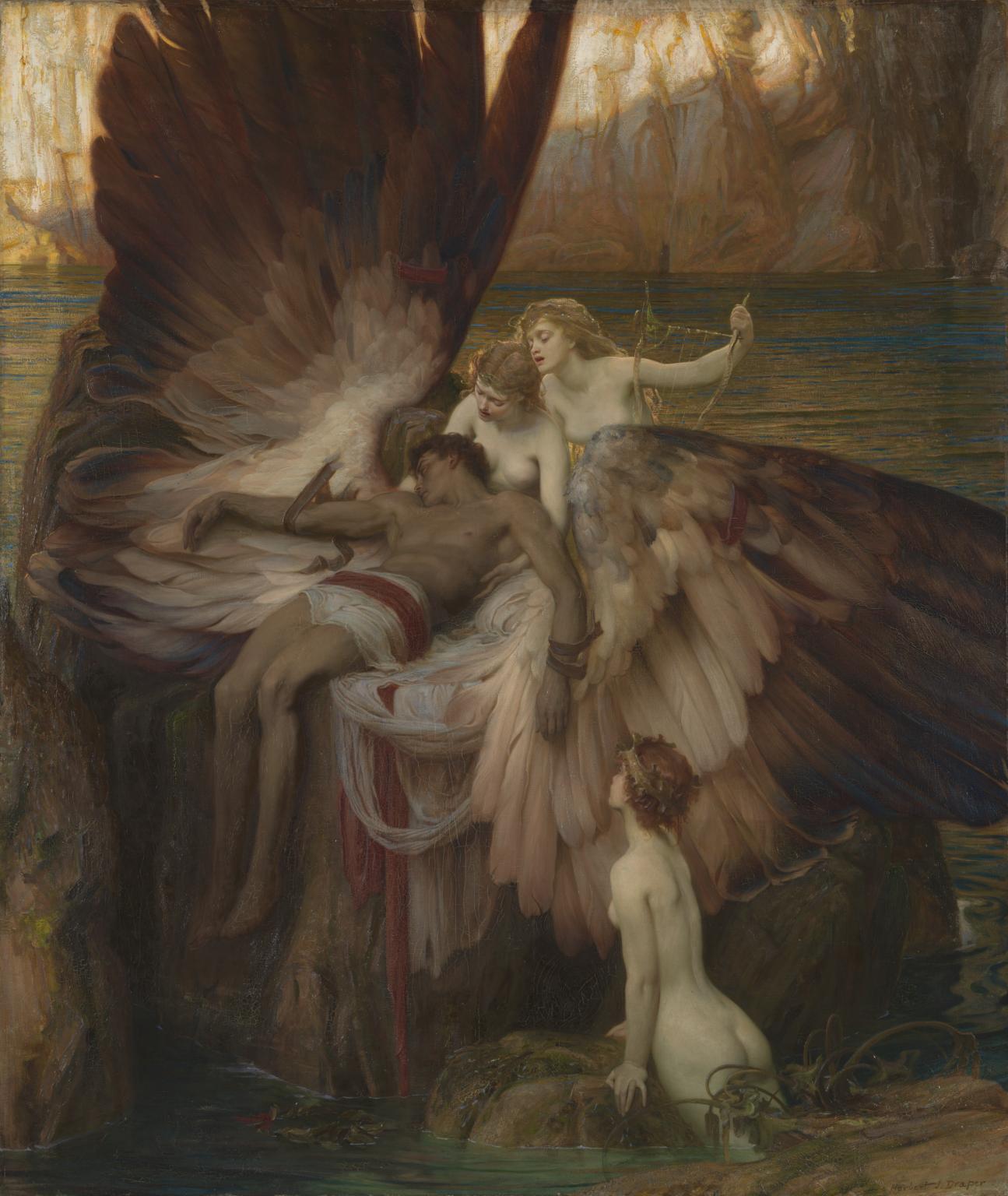
Herbert Draper, The Lament for Icarus exhibited 1898
Icarus’s father, the inventor Daedalus, made wings that allowed them to fly away from their island prison. The exhilarated Icarus forgot warnings and soared too close to the sun, melting the wax that secured the feathers, and he fell to his death. Charles Darwin’s publication of On the Origin of Species in 1859 gave an optimistic picture of the present and future evolution of humankind, but it also introduced ideas of a deep and obscure past. Art and literature took up this theme of origins, man’s mythical history and struggles between animal and human nature.
Gallery label, February 2016
24/30
artworks in Art for the Crowd
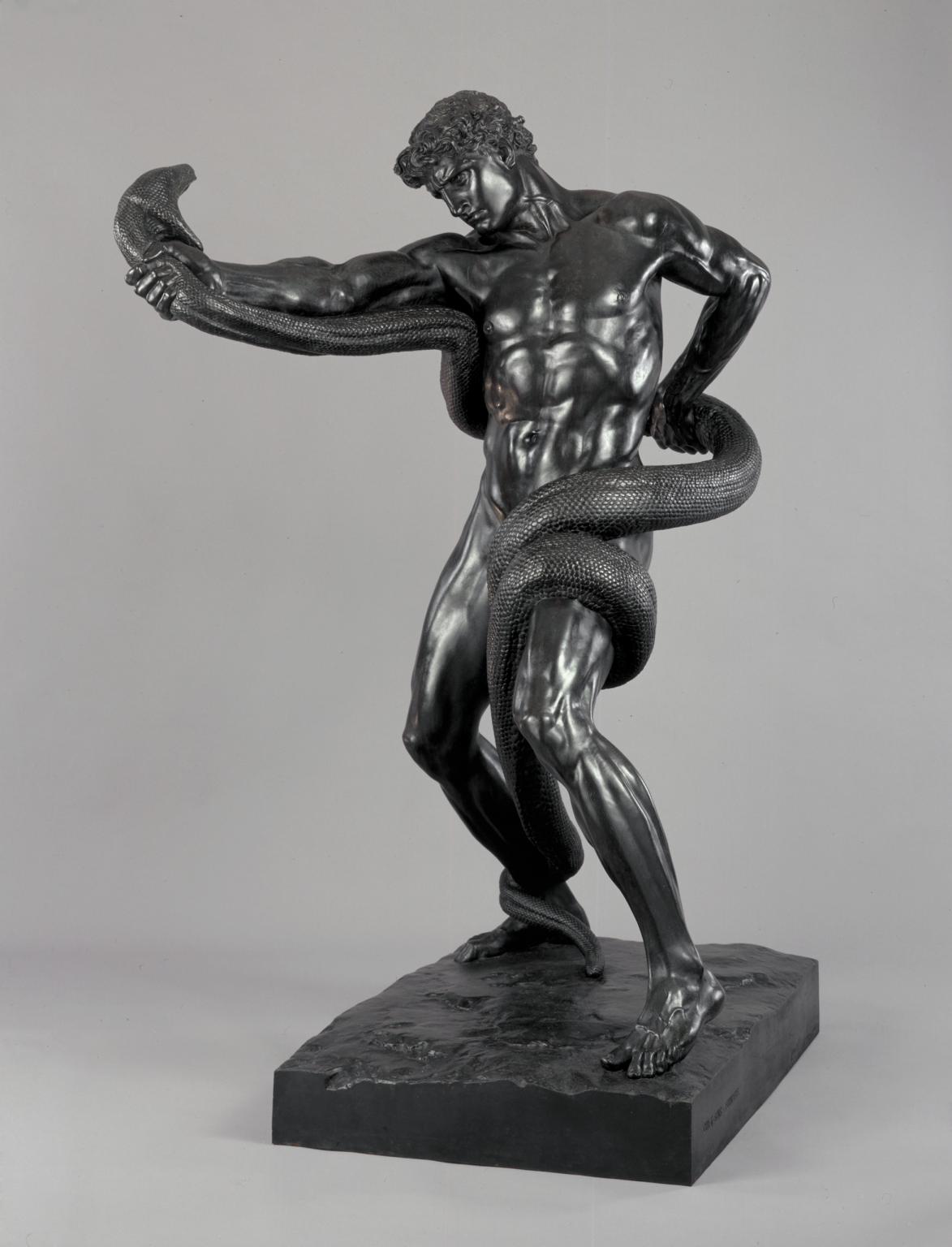
Frederic, Lord Leighton, An Athlete Wrestling with a Python 1877
This is the earlier of Frederic Leighton’s only two life-size sculptures, both made with the assistance of Thomas Brock. In subject and scale it was intended as a challenge to one of the greatest classical sculptures, The Laocoön, which shows three men being crushed by sea serpents. Frederic Leighton was a pioneer of what became known as the ‘New Sculpture’ movement in Britain. This fresh approach looked back to classical sculpture while focusing on the naturalism of the body through careful modelling of the surface. This coincided with a revival of interest in bronze, the lost wax technique used here allowing for precision in the treatment of form.
Gallery label, November 2016
25/30
artworks in Art for the Crowd
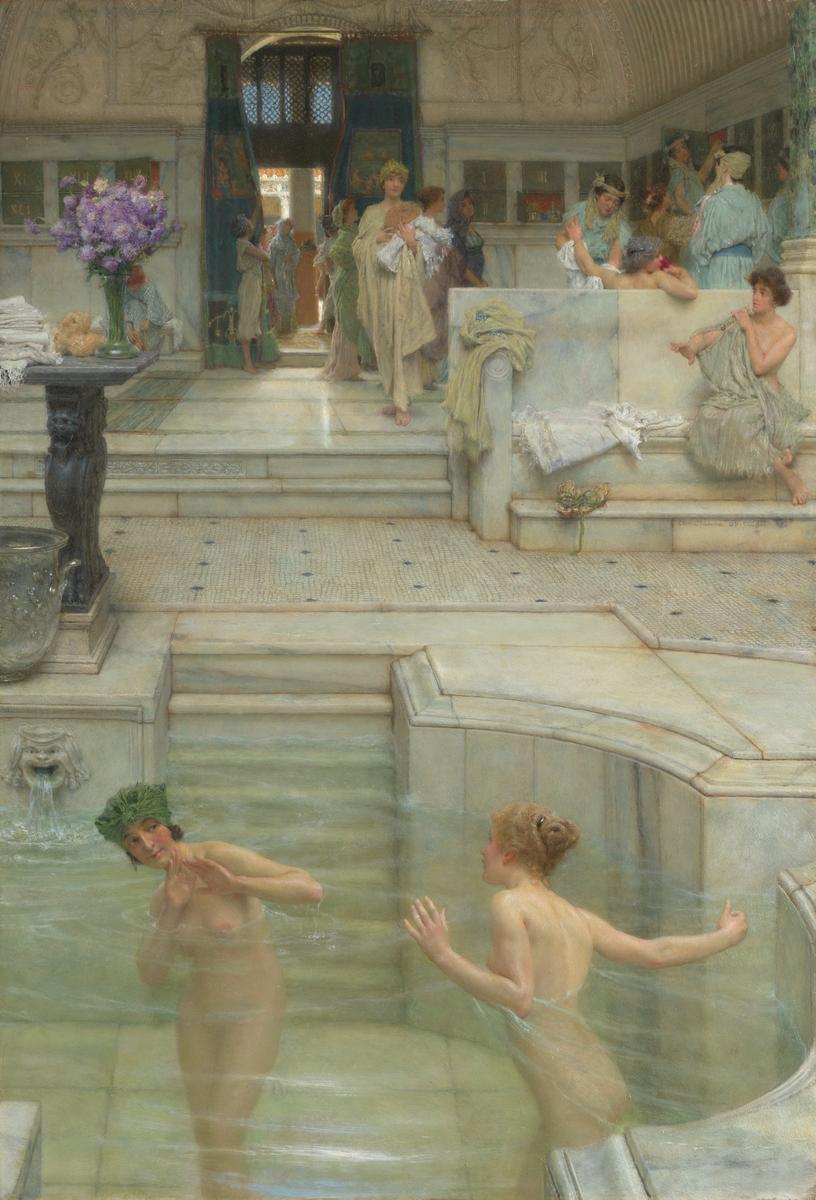
Sir Lawrence Alma-Tadema, A Favourite Custom 1909
This scene is set in the baths at Pompeii. In the foreground one woman playfully splashes another bathing in the ‘frigidarium’, a cold bath. The artist based this work on photographs of the ruins of the Stabian baths, revealed by archaeologists in 1824. He has made them more luxurious by adding a marble floor and walls which would more usually have been found in larger imperial baths. This small work attracted enormous success when it was exhibited and bought immediately for the nation.
Gallery label, February 2016
26/30
artworks in Art for the Crowd
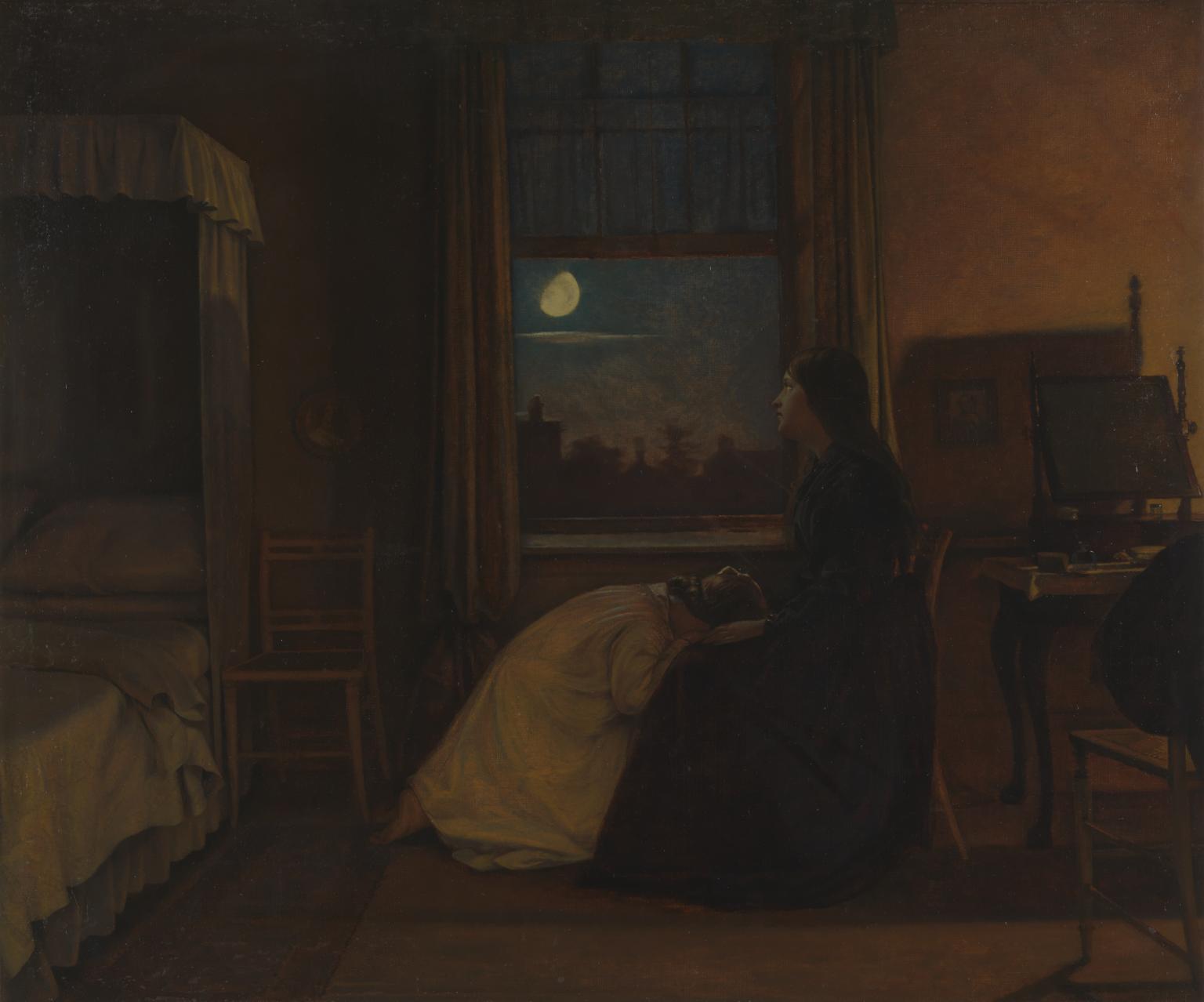
Augustus Leopold Egg, Past and Present, No. 2 1858
This forms part of a series of three paintings which consider the consequences of love outside marriage in Victorian Britain. This painting, Past, acts as the central scene, showing a wife begging forgiveness from her husband while their children look on. He holds a letter which reveals an affair and stamps on a portrait miniature of her lover. The room is full of symbols of the family’s downfall, such as the apple cut in two.
Gallery label, May 2023
27/30
artworks in Art for the Crowd
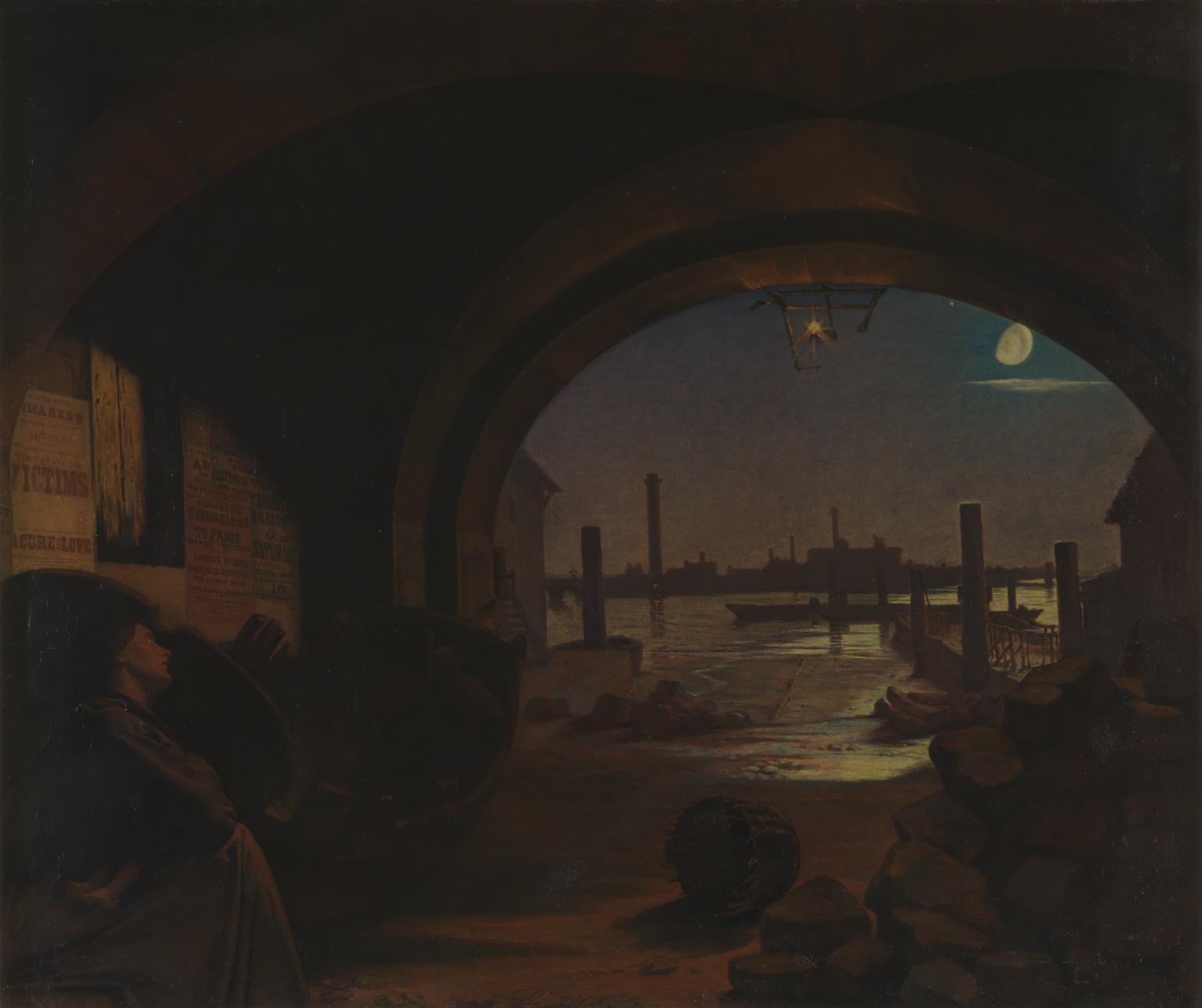
Augustus Leopold Egg, Past and Present, No. 3 1858
This painting forms part of a series of three which considers the consequences of love outside marriage In Victorian Britain. Past and Present No.1 and Past and Present No. 3 show ‘Present’ five years later, two weeks after the husband has died of despair. Identical moons indicate that they take place at the same moment. The two girls comfort each other. The homeless mother shelters under the Adelphi arches, by the River Thames in London, holding the baby that resulted from her affair. The posters for two plays, ‘Victims’ and ‘A Cure for Love’, and ‘Pleasure Excursions to Paris’, are ironic comments on her situation.
Gallery label, May 2023
28/30
artworks in Art for the Crowd
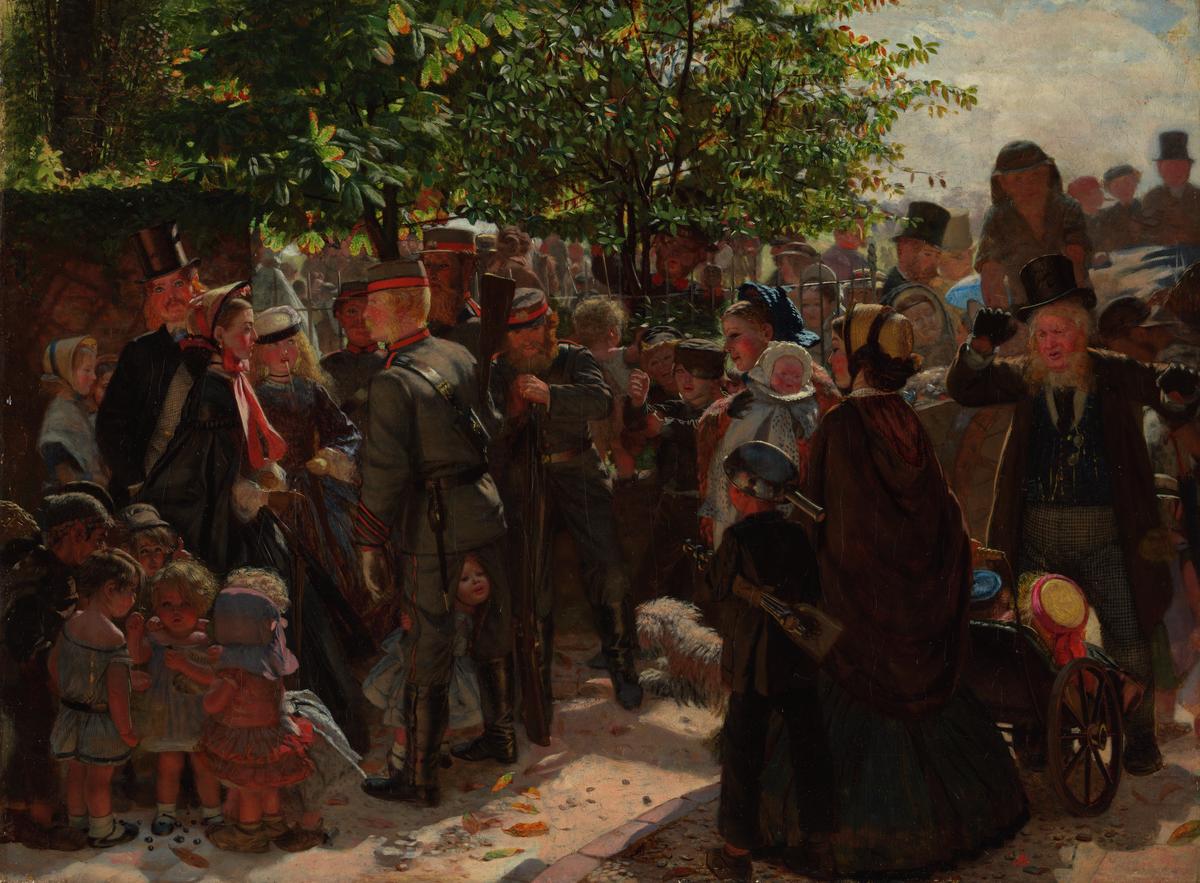
Arthur Boyd Houghton, Volunteers 1861
This painting shows a group of infantrymen recruiting for the Volunteer Movement which swept Britain between 1859 and 1860. It was fuelled by the revolutions in Continental Europe in 1848 and British mistrust of France.As Houghton shows in this painting, the volunteers were mainly recruited from the middle classes. They felt it was their patriotic duty to enlist in one of the volunteer battalions. But there appears to be a general lack of interest from the civilians in this painting. The gentleman on the left is carefully not looking at the soldiers.
Gallery label, July 2007
29/30
artworks in Art for the Crowd
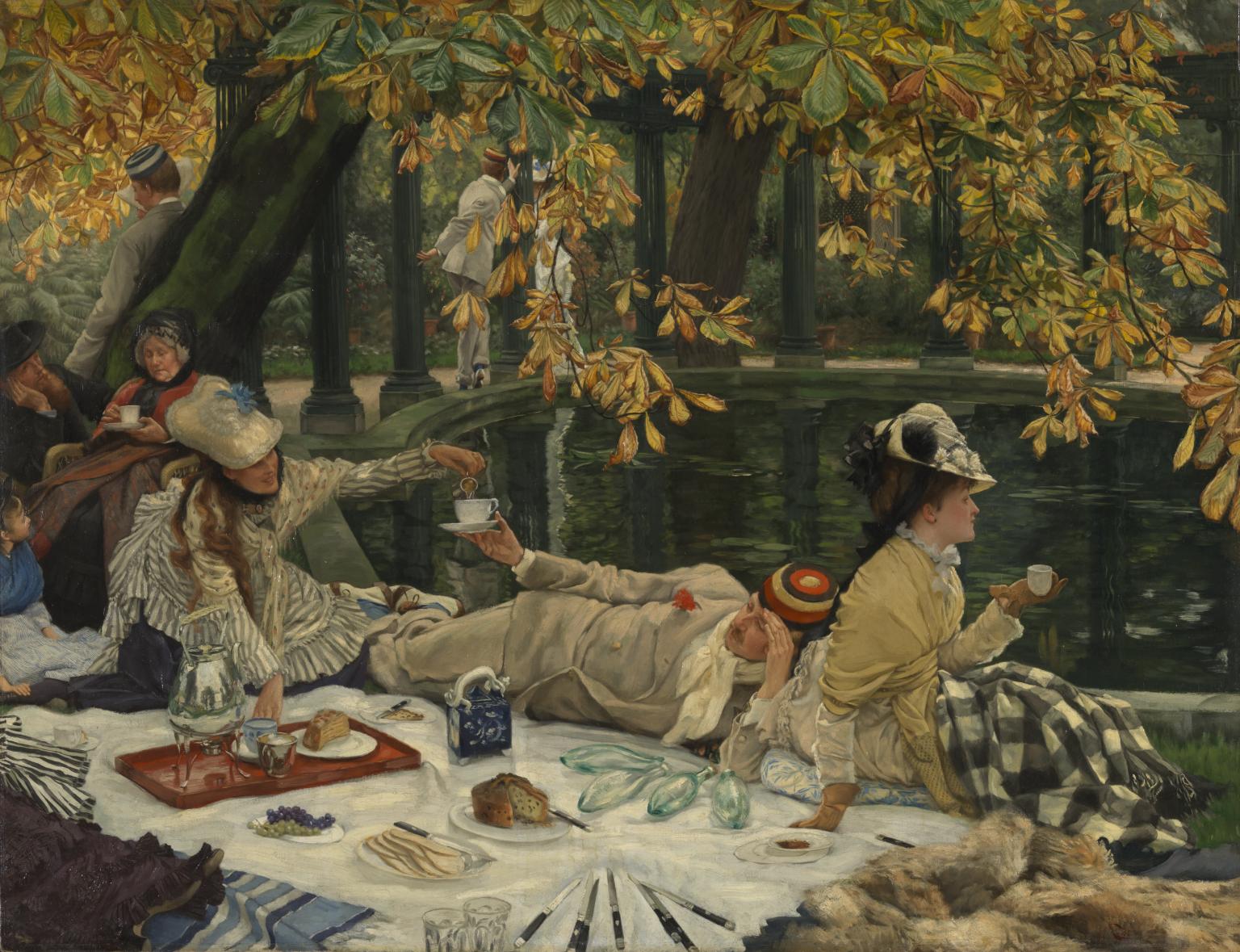
James Tissot, Holyday c.1876
This painting is set in the artist’s garden in the wealthy north London suburb of St John’s Wood. It features its distinctive cast-iron colonnade enclosing a large ornamental fishpond. St John’s Wood was considered a rather louche area and this picture of young people flirting, unnoticed by their sleeping chaperone, was considered by some to be rather vulgar. The men are wearing the caps of I Zingari, an elite amateur cricket club.James Tissot had fled to London in 1870 after the fall of the Paris Commune, and stayed until 1882.
Gallery label, July 2007
30/30
artworks in Art for the Crowd
Art in this room
John William Waterhouse
The Lady of Shalott
1888
Frederic, Lord Leighton
The Bath of Psyche
exhibited 1890
Henry Scott Tuke
August Blue
1893–4
John Singer Sargent
Carnation, Lily, Lily, Rose
1885–6
Sir Edward Coley Burne-Jones, Bt
The Golden Stairs
1880
Augustus Leopold Egg
Past and Present, No. 1
1858
You've viewed 6/30 artworks
You've viewed 30/30 artworks